


Page 38 - Read Online
P. 38
Lyulcheva-Bennett et al. J Transl Genet Genom 2023;7:259-73  https://dx.doi.org/10.20517/jtgg.2023.33   Page 269

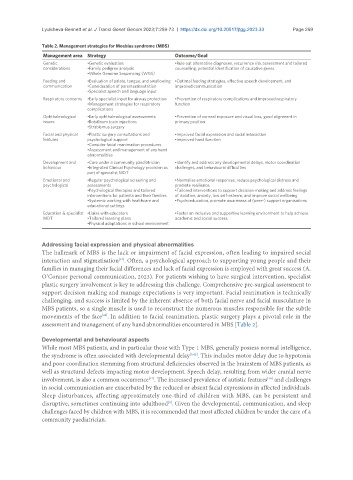
               Table 2. Management strategies for Moebius syndrome (MBS)
                Management area Strategy                    Outcome/Goal
                Genetic       •Genetic evaluation           •Rule out alternative diagnoses, recurrence risk assessment and tailored
                considerations  •Family pedigree analysis    counselling, potential identification of causative genes
                              •Whole Genome Sequencing (WGS)
                Feeding and   •Evaluation of palate, tongue, and swallowing  •Optimal feeding strategies, effective speech development, and
                communication  •Consideration of parenteral nutrition   improved communication
                              •Specialist speech and language input
                Respiratory concerns  •Early specialist input for airway protection   •Prevention of respiratory complications and improved respiratory
                              •Management strategies for respiratory   function
                              complications
                Ophthalmological   •Early ophthalmological assessments    •Prevention of corneal exposure and visual loss; good alignment in
                issues        •Botulinum toxin injections   primary position
                              •Strabismus surgery
                Facial and physical   •Plastic surgery consultations and   •Improved facial expression and social interaction
                features      psychological support         •Improved hand function
                              •Consider facial reanimation procedures
                              •Assessment and management of any hand
                              abnormalities
                Development and   •Care under a community paediatrician   •Identify and address any developmental delays, motor coordination
                behaviour     •Integrated Clinical Psychology provision as   challenges, and behavioural difficulties
                              part of specialist MDT
                Emotional and   •Regular psychological screening and   •Normalise emotional responses, reduce psychological distress and
                psychological  assessments                  promote resilience.
                              •Psychological therapies and tailored   •Tailored interventions to support decision-making and address feelings
                              interventions for patients and their families   of isolation, anxiety, low self-esteem, and improve social wellbeing
                              •Systemic working with healthcare and   •Psychoeducation, promote awareness of (peer-) support organisations
                              educational settings
                Education & specialist  •Liaise with educators   •Foster an inclusive and supportive learning environment to help achieve
                MDT           •Tailored learning plans      academic and social success
                              •Physical adaptations in school environment


               Addressing facial expression and physical abnormalities
               The hallmark of MBS is the lack or impairment of facial expression, often leading to impaired social
               interaction and stigmatisation . Often, a psychological approach to supporting young people and their
                                         [44]
               families in managing their facial differences and lack of facial expression is employed with great success (A.
               O’Connor personal communication, 2023). For patients wishing to have surgical intervention, specialist
               plastic surgery involvement is key to addressing this challenge. Comprehensive pre-surgical assessment to
               support decision making and manage expectations is very important. Facial reanimation is technically
               challenging, and success is limited by the inherent absence of both facial nerve and facial musculature in
               MBS patients, so a single muscle is used to reconstruct the numerous muscles responsible for the subtle
               movements of the face . In addition to facial reanimation, plastic surgery plays a pivotal role in the
                                   [45]
               assessment and management of any hand abnormalities encountered in MBS [Table 2].

               Developmental and behavioural aspects
               While most MBS patients, and in particular those with Type 1 MBS, generally possess normal intelligence,
               the syndrome is often associated with developmental delay [5,42] . This includes motor delay due to hypotonia
               and poor coordination stemming from structural deficiencies observed in the brainstem of MBS patients, as
               well as structural defects impacting motor development. Speech delay, resulting from wider cranial nerve
               involvement, is also a common occurrence . The increased prevalence of autistic features  and challenges
                                                   [42]
                                                                                           [46]
               in social communication are exacerbated by the reduced or absent facial expressions in affected individuals.
               Sleep disturbances, affecting approximately one-third of children with MBS, can be persistent and
                                                          [8]
               disruptive, sometimes continuing into adulthood . Given the developmental, communication, and sleep
               challenges faced by children with MBS, it is recommended that most affected children be under the care of a
               community paediatrician.

