


Page 25 - Read Online
P. 25
Bergara-Muguruza et al. J Transl Genet Genom 2023;7:213-229  https://dx.doi.org/10.20517/jtgg.2023.14  Page 217


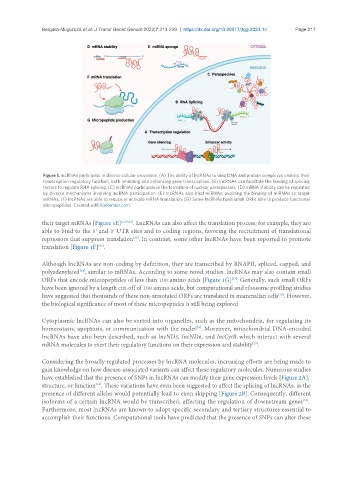
                Figure 1. lncRNAs participate in diverse cellular processes. (A) The ability of lncRNAs to bind DNA and protein complexes enables their
                transcription regulatory function, both inhibiting and enhancing gene transcription. (B) lncRNAs can facilitate the binding of splicing
                factors to regulate RNA splicing. (C) lncRNAs participate in the formation of nuclear paraspeckles. (D) mRNA stability can be regulated
                by diverse mechanisms involving lncRNA participation. (E) lncRNAs also bind miRNAs, avoiding the binding of miRNAs to target
                mRNAs. (F) lncRNAs are able to reduce or activate mRNA translation. (G) Some lncRNAs have small ORFs able to produce functional
                micropeptides. Created with BioRender.com.

               their target mRNAs [Figure 1E] [2,15,34] . LncRNAs can also affect the translation process; for example, they are
               able to bind to the 5′ and 3′ UTR sites and to coding regions, favoring the recruitment of translational
                                              [35]
               repressors that suppress translation . In contrast, some other lncRNAs have been reported to promote
               translation [Figure 1F] .
                                  [36]
               Although lncRNAs are non-coding by definition, they are transcribed by RNAPII, spliced, capped, and
                            [18]
               polyadenylated , similar to mRNAs. According to some novel studies, lncRNAs may also contain small
                                                                               [37]
               ORFs that encode micropeptides of less than 100 amino acids [Figure 1G] . Generally, such small ORFs
               have been ignored by a length cut-off of 100 amino acids, but computational and ribosome profiling studies
               have suggested that thousands of these non-annotated ORFs are translated in mammalian cells . However,
                                                                                               [38]
               the biological significance of most of these micropeptides is still being explored.


               Cytoplasmic lncRNAs can also be sorted into organelles, such as the mitochondria, for regulating its
               homeostasis, apoptosis, or communication with the nuclei . Moreover, mitochondrial DNA-encoded
                                                                   [39]
               lncRNAs have also been described, such as lncND5, lncND6, and lncCytB, which interact with several
               mRNA molecules to exert their regulatory functions on their expression and stability .
                                                                                      [15]
               Considering the broadly regulated processes by lncRNA molecules, increasing efforts are being made to
               gain knowledge on how disease-associated variants can affect these regulatory molecules. Numerous studies
               have established that the presence of SNPs in lncRNAs can modify their gene expression levels [Figure 2A],
               structure, or function . These variations have even been suggested to affect the splicing of lncRNAs, as the
                                 [13]
               presence of different alleles would potentially lead to exon skipping [Figure 2B]. Consequently, different
               isoforms of a certain lncRNA would be transcribed, affecting the regulation of downstream genes .
                                                                                                       [13]
               Furthermore, most lncRNAs are known to adopt specific secondary and tertiary structures essential to
               accomplish their functions. Computational tools have predicted that the presence of SNPs can alter these

