


Page 98 - Read Online
P. 98
Wang et al. J. Mater. Inf. 2026, 6, 9                                             Page 5 of 15


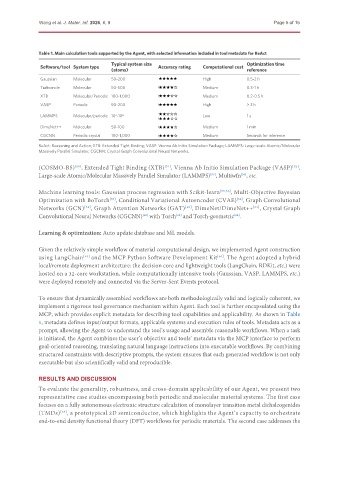
               Table 1. Main calculation tools supported by the Agent, with selected information included in tool metadata for ReAct
                                        Typical system size                             Optimization time
               Software/tool System type                 Accuracy rating  Computational cost
                                        (atoms)                                         reference
               Gaussian    Molecular    50-200                          High            0.5-2 h
               Turbomole   Molecular    50-500                          Medium          0.3-1 h
               XTB         Molecular/Periodic 100-1,000                 Medium          0.2-0.5 h
               VASP        Periodic     50-200                          High            > 2 h

                                          3
               LAMMPS      Molecular/periodic 10 -10 6                  Low             1 s
               DimeNet++   Molecular    50-100                          Medium          1 min
               CGCNN       Periodic crystal  100-1,000                  Medium          Seconds for inference
               ReAct: Reasoning and Action; XTB: Extended Tight Binding; VASP: Vienna Ab Initio Simulation Package; LAMMPS: Large-scale Atomic/Molecular
               Massively Parallel Simulator; CGCNN: Crystal Graph Convolutional Neural Networks.

               (COSMO-RS) , Extended Tight Binding (XTB) , Vienna Ab Initio Simulation Package (VASP) ,
                                                           [51]
                                                                                                        [52]
                           [50]
               Large-scale Atomic/Molecular Massively Parallel Simulator (LAMMPS) , Multiwfn , etc.
                                                                           [53]
                                                                                      [54]
               Machine learning tools: Gaussian process regression with Scikit-learn [55,56] , Multi-Objective Bayesian
               Optimization with BoTorch , Conditional Variational Autoencoder (CVAE) , Graph Convolutional
                                                                                    [58]
                                        [57]
               Networks (GCN) , Graph Attention Networks (GAT) , DimeNet/DimeNet++ , Crystal Graph
                                                                                          [61]
                               [59]
                                                                  [60]
               Convolutional Neural Networks (CGCNN)  with Torch  and Torch-geometric .
                                                               [63]
                                                                                   [64]
                                                   [62]
               Learning & optimization: Auto update database and ML models.
               Given the relatively simple workflow of material computational design, we implemented Agent construction
               using LangChain  and the MCP Python Software Development Kit . The Agent adopted a hybrid
                              [65]
                                                                             [66]
               local/remote deployment architecture: the decision core and lightweight tools (LangChain, RDKit, etc.) were
               hosted on a 32-core workstation, while computationally intensive tools (Gaussian, VASP, LAMMPS, etc.)
               were deployed remotely and connected via the Server-Sent Events protocol.
               To ensure that dynamically assembled workflows are both methodologically valid and logically coherent, we
               implement a rigorous tool governance mechanism within Agent. Each tool is further encapsulated using the
               MCP, which provides explicit metadata for describing tool capabilities and applicability. As shown in Table
               1, metadata defines input/output formats, applicable systems and execution rules of tools. Metadata acts as a
               prompt, allowing the Agent to understand the tool’s usage and assemble reasonable workflows. When a task
               is initiated, the Agent combines the user’s objective and tools’ metadata via the MCP interface to perform
               goal-oriented reasoning, translating natural language instructions into executable workflows. By combining
               structured constraints with descriptive prompts, the system ensures that each generated workflow is not only
               executable but also scientifically valid and reproducible.


               RESULTS AND DISCUSSION
               To evaluate the generality, robustness, and cross-domain applicability of our Agent, we present two
               representative case studies encompassing both periodic and molecular material systems. The first case
               focuses on a fully autonomous electronic structure calculation of monolayer transition metal dichalcogenides
               (TMDs) , a prototypical 2D semiconductor, which highlights the Agent’s capacity to orchestrate
                      [67]
               end-to-end density functional theory (DFT) workflows for periodic materials. The second case addresses the

