


Page 103 - Read Online
P. 103
Page 10 of 15                                                     Wang et al. J. Mater. Inf. 2026, 6, 9


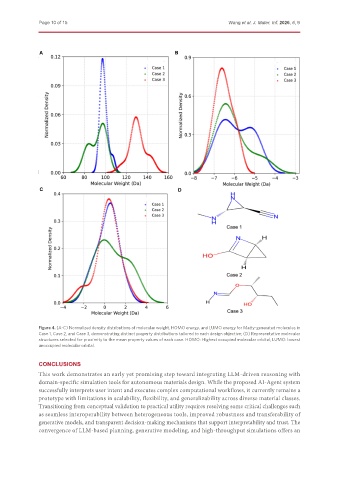
               Figure 4. (A-C) Normalized density distributions of molecular weight, HOMO energy, and LUMO energy for Matty-generated molecules in
               Case 1, Case 2, and Case 3, demonstrating distinct property distributions tailored to each design objective; (D) Representative molecular
               structures selected for proximity to the mean property values of each case. HOMO: Highest occupied molecular orbital; LUMO: lowest
               unoccupied molecular orbital.


               CONCLUSIONS
               This work demonstrates an early yet promising step toward integrating LLM-driven reasoning with
               domain-specific simulation tools for autonomous materials design. While the proposed AI-Agent system
               successfully interprets user intent and executes complex computational workflows, it currently remains a
               prototype with limitations in scalability, flexibility, and generalizability across diverse material classes.
               Transitioning from conceptual validation to practical utility requires resolving some critical challenges such
               as seamless interoperability between heterogeneous tools, improved robustness and transferability of
               generative models, and transparent decision-making mechanisms that support interpretability and trust. The
               convergence of LLM-based planning, generative modeling, and high-throughput simulations offers an

