


Page 102 - Read Online
P. 102
Wang et al. J. Mater. Inf. 2026, 6, 9                                             Page 9 of 15


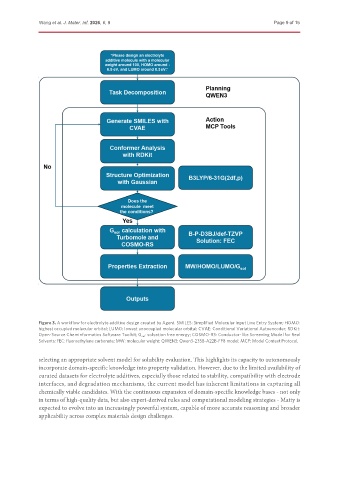
               Figure 3. A workflow for electrolyte additive design created by Agent. SMILES: Simplified Molecular Input Line Entry System; HOMO:
               highest occupied molecular orbital; LUMO: lowest unoccupied molecular orbital; CVAE: Conditional Variational Autoencoder; RDKit:
               Open-Source Cheminformatics Software Toolkit; G sol : solvation free energy; COSMO-RS: Conductor-like Screening Model for Real
               Solvents; FEC: fluoroethylene carbonate; MW: molecular weight; QWEN3: Qwen3-235B-A22B-FP8 model; MCP: Model Context Protocol.


               selecting an appropriate solvent model for solubility evaluation. This highlights its capacity to autonomously
               incorporate domain-specific knowledge into property validation. However, due to the limited availability of
               curated datasets for electrolyte additives, especially those related to stability, compatibility with electrode
               interfaces, and degradation mechanisms, the current model has inherent limitations in capturing all
               chemically viable candidates. With the continuous expansion of domain-specific knowledge bases - not only
               in terms of high-quality data, but also expert-derived rules and computational modeling strategies - Matty is
               expected to evolve into an increasingly powerful system, capable of more accurate reasoning and broader
               applicability across complex materials design challenges.

