


Page 97 - Read Online
P. 97
Page 4 of 15                                                      Wang et al. J. Mater. Inf. 2026, 6, 9


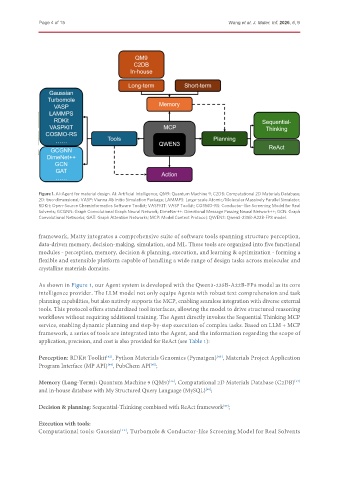
               Figure 1. AI-Agent for material design. AI: Artificial Intelligence; QM9: Quantum Machine 9; C2DB: Computational 2D Materials Database;
               2D: two-dimensional; VASP: Vienna Ab Initio Simulation Package; LAMMPS: Large-scale Atomic/Molecular Massively Parallel Simulator;
               RDKit: Open-Source Cheminformatics Software Toolkit; VASPKIT: VASP Toolkit; COSMO-RS: Conductor-like Screening Model for Real
               Solvents; GCGNN: Graph Convolutional Graph Neural Network; DimeNer++: Directional Message Passing Neural Network++; GCN: Graph
               Convolutional Networks; GAT: Graph Attention Networks; MCP: Model Context Protocol; QWEN3: Qwen3-235B-A22B-FP8 model.


               framework, Matty integrates a comprehensive suite of software tools spanning structure perception,
               data-driven memory, decision-making, simulation, and ML. These tools are organized into five functional
               modules - perception, memory, decision & planning, execution, and learning & optimization - forming a
               flexible and extensible platform capable of handling a wide range of design tasks across molecular and
               crystalline materials domains.

               As shown in Figure 1, our Agent system is developed with the Qwen3-235B-A22B-FP8 model as its core
               intelligence provider. The LLM model not only equips Agents with robust text comprehension and task
               planning capabilities, but also natively supports the MCP, enabling seamless integration with diverse external
               tools. This protocol offers standardized tool interfaces, allowing the model to drive structured reasoning
               workflows without requiring additional training. The Agent directly invokes the Sequential Thinking MCP
               service, enabling dynamic planning and step-by-step execution of complex tasks. Based on LLM + MCP
               framework, a series of tools are integrated into the Agent, and the information regarding the scope of
               application, precision, and cost is also provided for ReAct (see Table 1):

               Perception: RDKit Toolkit , Python Materials Genomics (Pymatgen) , Materials Project Application
                                      [42]
                                                                             [43]
               Program Interface (MP API) , PubChem API ;
                                       [44]
                                                      [45]
               Memory (Long-Term): Quantum Machine 9 (QM9) , Computational 2D Materials Database (C2DB) [47]
                                                            [46]
               and in-house database with My Structured Query Language (MySQL) ;
                                                                         [48]
               Decision & planning: Sequential-Thinking combined with ReAct framework ;
                                                                               [39]

               Execution with tools:
               Computational tools: Gaussian , Turbomole & Conductor-like Screening Model for Real Solvents
                                           [49]

