


Page 55 - Read Online
P. 55
Hu et al. J. Mater. Inf. 2025, 5, 44  https://dx.doi.org/10.20517/jmi.2025.21    Page 5 of 17


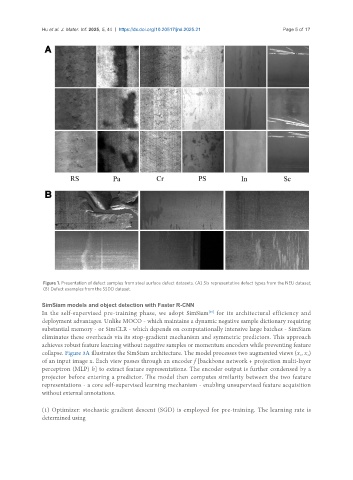
                Figure 1. Presentation of defect samples from steel surface defect datasets. (A) Six representative defect types from the NEU dataset;
                (B) Defect examples from the SSDD dataset.


               SimSiam models and object detection with Faster R-CNN
               In the self-supervised pre-training phase, we adopt SimSiam  for its architectural efficiency and
                                                                       [38]
               deployment advantages. Unlike MOCO - which maintains a dynamic negative sample dictionary requiring
               substantial memory - or SimCLR - which depends on computationally intensive large batches - SimSiam
               eliminates these overheads via its stop-gradient mechanism and symmetric predictors. This approach
               achieves robust feature learning without negative samples or momentum encoders while preventing feature
               collapse. Figure 3A illustrates the SimSiam architecture. The model processes two augmented views (x , x )
                                                                                                         2
                                                                                                      1
               of an input image x. Each view passes through an encoder f [backbone network + projection multi-layer
               perceptron (MLP) h] to extract feature representations. The encoder output is further condensed by a
               projector before entering a predictor. The model then computes similarity between the two feature
               representations - a core self-supervised learning mechanism - enabling unsupervised feature acquisition
               without external annotations.

               (1) Optimizer: stochastic gradient descent (SGD) is employed for pre-training. The learning rate is
               determined using

