


Page 232 - Read Online
P. 232
Page 10 of 13                                                     Yuan et al. J. Mater. Inf. 2026, 6, 17


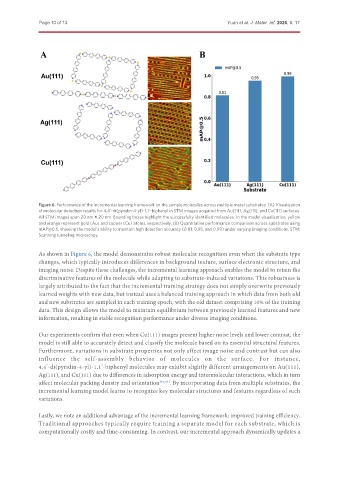
               Figure 6. Performance of the incremental learning framework on the sample molecules across multiple metal substrates. (A) Visualization
               of molecular detection results for 4,4’-di(pyridin-4-yl)-1,1’-biphenyl in STM images acquired from Au(111), Ag(111), and Cu(111) surfaces.
               All STM images span 20 nm × 20 nm. Bounding boxes highlight the successfully identified molecules. In the model visualization, yellow
               and orange represent gold (Au) and copper (Cu) atoms, respectively; (B) Quantitative performance comparison across substrates using
               mAP@0.5, showing the model’s ability to maintain high detection accuracy (0.81, 0.95, and 0.99) under varying imaging conditions. STM:
               Scanning tunneling microscopy.

               As shown in Figure 6, the model demonstrates robust molecular recognition even when the substrate type
               changes, which typically introduces differences in background texture, surface electronic structure, and
               imaging noise. Despite these challenges, the incremental learning approach enables the model to retain the
               discriminative features of the molecule while adapting to substrate-induced variations. This robustness is
               largely attributed to the fact that the incremental training strategy does not simply overwrite previously
               learned weights with new data, but instead uses a balanced training approach in which data from both old
               and new substrates are sampled in each training epoch, with the old dataset comprising 10% of the training
               data. This design allows the model to maintain equilibrium between previously learned features and new
               information, resulting in stable recognition performance under diverse imaging conditions.

               Our experiments confirm that even when Cu(111) images present higher noise levels and lower contrast, the
               model is still able to accurately detect and classify the molecule based on its essential structural features.
               Furthermore, variations in substrate properties not only affect image noise and contrast but can also
               influence   the   self-assembly   behavior   of   molecules   on   the   surface.   For   instance,
               4,4’-di(pyridin-4-yl)-1,1’-biphenyl molecules may exhibit slightly different arrangements on Au(111),
               Ag(111), and Cu(111) due to differences in adsorption energy and intermolecular interactions, which in turn
               affect molecular packing density and orientation [33,34] . By incorporating data from multiple substrates, the
               incremental learning model learns to recognize key molecular structures and features regardless of such
               variations.


               Lastly, we note an additional advantage of the incremental learning framework: improved training efficiency.
               Traditional approaches typically require training a separate model for each substrate, which is
               computationally costly and time-consuming. In contrast, our incremental approach dynamically updates a

