


Page 230 - Read Online
P. 230
Page 8 of 13                                                      Yuan et al. J. Mater. Inf. 2026, 6, 17


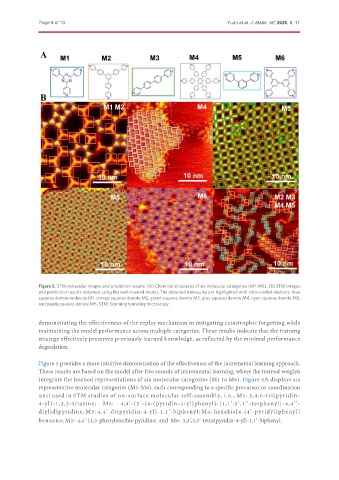
               Figure 5. STM molecular images and prediction results. (A) Chemical structures of six molecular categories (M1-M6); (B) STM images
               and prediction results obtained using the well-trained model. The detected molecules are highlighted with color-coded markers: blue
               squares denote molecule M1, orange squares denote M2, green squares denote M3, grey squares denote M4, cyan squares denote M5,
               and purple squares denote M6. STM: Scanning tunneling microscopy.


               demonstrating the effectiveness of the replay mechanism in mitigating catastrophic forgetting while
               maintaining the model performance across multiple categories. These results indicate that the training
               strategy effectively preserves previously learned knowledge, as reflected by the minimal performance
               degradation.

               Figure 5 provides a more intuitive demonstration of the effectiveness of the incremental learning approach.
               These results are based on the model after five rounds of incremental learning, where the trained weights
               integrate the learned representations of six molecular categories (M1 to M6). Figure 5A displays six
               representative molecular categories (M1-M6), each corresponding to a specific precursor or coordination
               unit used in STM studies of on-surface molecular self-assembly, i.e., M1: 2,4,6-tri(pyridin-
               4-yl)-1,3,5-triazine;  M2: 4,4’-(5’-(4-(pyridin-4-yl)phenyl)-[1,1’:3’,1’’-terphenyl]-4,4’’-
               diyl)dipyridine; M3: 4,4’-di(pyridin-4-yl)-1,1’-biphenyl; M4: hexakis[4-(4’-pyridyl)phenyl]
               benzene; M5: 4,4’-(1,3-phenylene)bis-pyridine;  and  M6:  3,3’,5,5’-tetra(pyridin-4-yl)-1,1’-biphenyl.

