


Page 223 - Read Online
P. 223
Research Article  |  Open Access

                          Journal of Materials Informatics


                                         Yuan et al. J. Mater. Inf. 2026, 6, 17      DOI:10.20517/jmi.2025.78


               Computer vision for efficient object detection and
               segmentation in molecular image analysis


               Shaoxuan Yuan , Zhiwen Zhu , Jiayi Lu , Liangliang Cai 1,*  , Qiang Sun 1
                                        1
                            1,2
                                                 1
               Keywords:
               YOLOv9, object detection,
               instance segmentation,
               incremental learning,
               surface chemistry

               Citation: Yuan, S.; Zhu, Z.;
               Lu, J.; Cai, L.; Sun, Q.
               Computer vision for efficient
               object detection and
               segmentation in molecular
               image analysis. J. Mater. Inf.
               2026, 6, 17.
               https://dx.doi.org/10.20517
               /jmi.2025.78

               Received: 11 Sep 2025
               First Decision: 23 Oct
               2025                Abstract
               Revised: 27 Nov 2025
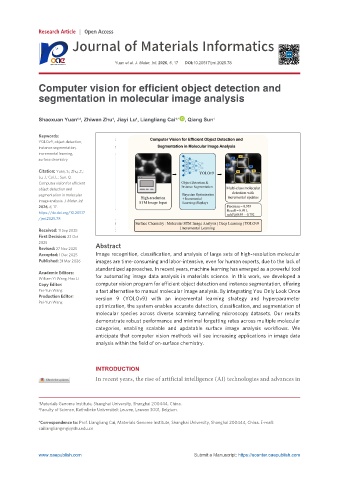
               Accepted: 1 Dec 2025  Image recognition, classification, and analysis of large sets of high-resolution molecular
               Published: 31 Mar 2026  images are time-consuming and labor-intensive, even for human experts, due to the lack of
                                   standardized approaches. In recent years, machine learning has emerged as a powerful tool
               Academic Editors:
               William Yi Wang, Hao Li  for  automating  image  data  analysis  in  materials  science.  In  this  work,  we  developed  a
               Copy Editor:        computer vision program for efficient object detection and instance segmentation, offering
               Pei-Yun Wang        a fast alternative to manual molecular image analysis. By integrating You Only Look Once
               Production Editor:  version   9   (YOLOv9)   with   an   incremental   learning   strategy   and   hyperparameter
               Pei-Yun Wang
                                   optimization, the system enables accurate detection, classification, and segmentation of
                                   molecular   species   across   diverse   scanning   tunneling   microscopy   datasets.   Our   results
                                   demonstrate robust performance and minimal forgetting rates across multiple molecular
                                   categories,   enabling   scalable   and   updatable   surface   image   analysis   workflows.   We
                                   anticipate  that  computer  vision  methods  will  see  increasing  applications  in  image  data
                                   analysis within the field of on-surface chemistry.


                                   INTRODUCTION
                                   In recent years, the rise of artificial intelligence (AI) technologies and advances in


               1 Materials Genome Institute, Shanghai University, Shanghai 200444, China.
               2 Faculty of Science, Katholieke Universiteit Leuven, Leuven 3001, Belgium.

               * Correspondence to: Prof. Liangliang Cai, Materials Genome Institute, Shanghai University, Shanghai 200444, China. E-mail:
               cailiangliangmgi@shu.edu.cn


               www.oaepublish.com                                    Submit a Manuscript: https://ucenter.oaepublish.com

