


Page 81 - Read Online
P. 81
Gesch et al. J. Mater. Inf. 2025, 5, 42  https://dx.doi.org/10.20517/jmi.2025.23  Page 3 of 20

               dependent machine learning models, such as recurrent neural networks (RNNs), to predict the evolution of
               microstructures in future time sequence [45-50] . PSMDs directly approximate the microstructural dynamics
               from their original two-dimensional (2D) or three-dimensional (3D) space using the physics-informed
               neural networks, such as neural operator learning. These PSDMs generally incorporate a temporal-
               conditioning mechanism, which can further improve the accuracy and efficiency of time-to-solution
               predictions for microstructural evolution. For instance, a deep-learning-based neural network with a U-Net
               architecture has been developed to predict the microstructural evolution for a range of phase-field
                                                                                            [51]
               problems, including spinodal decomposition, dendrite growth, and thin film deposition . Despite their
               outstanding performance, most existing accelerated frameworks, including both LDMs and PSDMs have
               been developed for relatively simple phase-field problems with a single evolution field, such as spinodal
               decomposition [45-49] . Accelerated frameworks for more complex, coupled microstructural evolution
               problems are still scarcely developed, thereby motivating this study.

                                                                                        [52]
               Using the classical benchmark problem Ostwald ripening as a modeling system , we in this work
               developed a highly integrated framework to accelerate the microstructural evolution of coupled phase fields.
               This accelerated framework integrates high-throughput phase-field modeling, dimensionality reduction,
               and long short-term memory (LSTM) networks to predict the microstructural evolution of Ostwald
               ripening in latent representations. Specifically, autoencoders are first used to transform the 2D
               microstructure images into a low-dimensional space for training LSTM models. Once trained, the LSTM
               models are employed to predict the temporal evolution of microstructures in the latent space, and then the
               autoencoder is used to reconstruct these predicted microstructure sequences back into the original 2D
               space. Finally, supervised learning techniques are applied to predict the correlations between coupled fields
               within the latent space, thereby further enhancing the overall efficiency of this accelerated phase-field
               framework.


               MATERIALS AND METHODS
               Figure 1 illustrates a simplified workflow of our accelerated framework for Ostwald ripening . The high-
                                                                                              [52]
               throughput phase-field simulations are first performed with various input parameters to generate a large
               database of microstructural evolution over time [Figure 1A]. Using the large number of microstructure
               images, we employ an autoencoder-based dimensionality reduction technique to reduce the data to the low-
               dimensional space. Specifically, each parameter field in Ostwald ripening can be defined by a continuous
               function X (x, t), where x and t represent a 2D spatial domain and time, respectively. After dimensionality
               reduction, the microstructure of each parameter field can be given by a multivariate time-series x = (x , x ,
                                                                                                        2
                                                                                                      1
               ..., x ), where x  is a vector in latent space and represents the reduced microstructure at time t = t   i
                   N
                             i
               [Figure 1B]. Next,  we  use  one  of  the  most  popular  RNN  models,  LSTM,  to  learn  the  nature  of
               microstructure evolution of Ostwald ripening in the latent space [Figure 1C]. This is realized by establishing
               a functional relationship among the low-dimensional representation x, the current time step t and prior
                                                                            i
                                                                                                 i
               lagged values (t , t ).
                            i-1
                               i-n
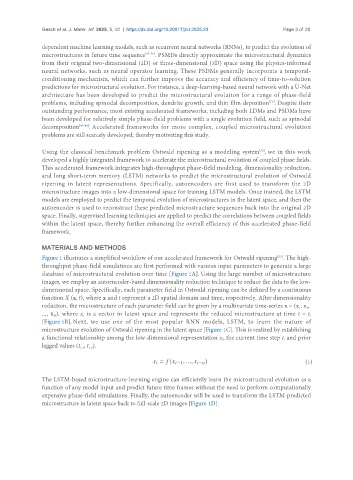
                                                                                                        (1)
               The LSTM-based microstructure-learning engine can efficiently learn the microstructural evolution as a
               function of any model input and predict future time frames without the need to perform computationally
               expensive phase-field simulations. Finally, the autoencoder will be used to transform the LSTM-predicted
               microstructure in latent space back to full-scale 2D images [Figure 1D].

