


Page 59 - Read Online
P. 59
Page 16 of 20                        Zhu et al. J. Mater. Inf. 2025, 5, 8  https://dx.doi.org/10.20517/jmi.2024.76


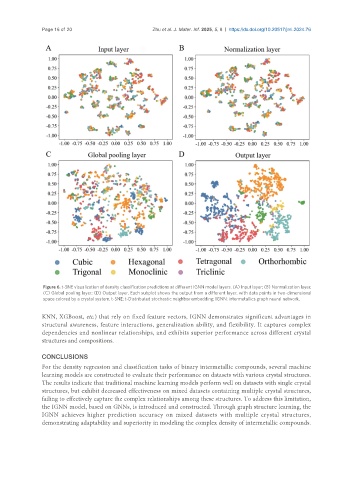
                Figure 6. t-SNE visualization of density classification predictions at different IGNN model layers. (A) Input layer; (B) Normalization layer;
                (C) Global pooling layer; (D) Output layer. Each subplot shows the output from a different layer, with data points in two-dimensional
                space colored by a crystal system. t-SNE: t-Distributed stochastic neighbor embedding; IGNN: intermetallics graph neural network.


               KNN, XGBoost, etc.) that rely on fixed feature vectors, IGNN demonstrates significant advantages in
               structural awareness, feature interactions, generalization ability, and flexibility. It captures complex
               dependencies and nonlinear relationships, and exhibits superior performance across different crystal
               structures and compositions.

               CONCLUSIONS
               For the density regression and classification tasks of binary intermetallic compounds, several machine
               learning models are constructed to evaluate their performance on datasets with various crystal structures.
               The results indicate that traditional machine learning models perform well on datasets with single crystal
               structures, but exhibit decreased effectiveness on mixed datasets containing multiple crystal structures,
               failing to effectively capture the complex relationships among these structures. To address this limitation,
               the IGNN model, based on GNNs, is introduced and constructed. Through graph structure learning, the
               IGNN  achieves  higher  prediction  accuracy  on  mixed  datasets  with  multiple  crystal  structures,
               demonstrating adaptability and superiority in modeling the complex density of intermetallic compounds.

