


Page 58 - Read Online
P. 58
Zhu et al. J. Mater. Inf. 2025, 5, 8  https://dx.doi.org/10.20517/jmi.2024.76   Page 15 of 20


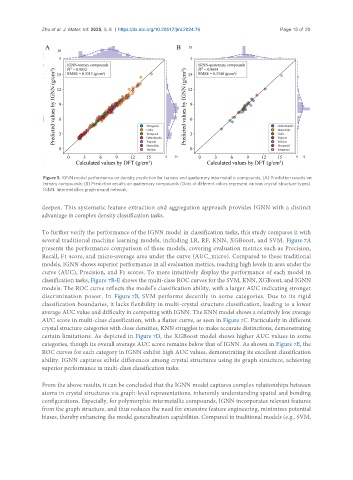
                Figure 5. IGNN model performance on density prediction for ternary and quaternary intermetallic compounds. (A) Prediction results on
                ternary compounds; (B) Prediction results on quaternary compounds (Dots of different colors represent various crystal structure types).
                IGNN: Intermetallics graph neural network.

               deepen. This systematic feature extraction and aggregation approach provides IGNN with a distinct
               advantage in complex density classification tasks.


               To further verify the performance of the IGNN model in classification tasks, this study compares it with
               several traditional machine learning models, including LR, RF, KNN, XGBoost, and SVM. Figure 7A
               presents the performance comparison of these models, covering evaluation metrics such as Precision,
               Recall, F1 score, and micro-average area under the curve (AUC_micro). Compared to these traditional
               models, IGNN shows superior performance in all evaluation metrics, reaching high levels in area under the
               curve (AUC), Precision, and F1 scores. To more intuitively display the performance of each model in
               classification tasks, Figure 7B-E shows the multi-class ROC curves for the SVM, KNN, XGBoost, and IGNN
               models. The ROC curve reflects the model’s classification ability, with a larger AUC indicating stronger
               discrimination power. In Figure 7B, SVM performs decently in some categories. Due to its rigid
               classification boundaries, it lacks flexibility in multi-crystal structure classification, leading to a lower
               average AUC value and difficulty in competing with IGNN. The KNN model shows a relatively low average
               AUC score in multi-class classification, with a flatter curve, as seen in Figure 7C. Particularly in different
               crystal structure categories with close densities, KNN struggles to make accurate distinctions, demonstrating
               certain limitations. As depicted in Figure 7D, the XGBoost model shows higher AUC values in some
               categories, though its overall average AUC score remains below that of IGNN. As shown in Figure 7E, the
               ROC curves for each category in IGNN exhibit high AUC values, demonstrating its excellent classification
               ability. IGNN captures subtle differences among crystal structures using its graph structure, achieving
               superior performance in multi-class classification tasks.

               From the above results, it can be concluded that the IGNN model captures complex relationships between
               atoms in crystal structures via graph-level representations, inherently understanding spatial and bonding
               configurations. Especially, for polymorphic intermetallic compounds, IGNN incorporates relevant features
               from the graph structure, and thus reduces the need for extensive feature engineering, minimizes potential
               biases, thereby enhancing the model generalization capabilities. Compared to traditional models (e.g., SVM,

