


Page 36 - Read Online
P. 36
Lu et al. J Mater Inf 2024;4:31  https://dx.doi.org/10.20517/jmi.2024.65         Page 9 of 16


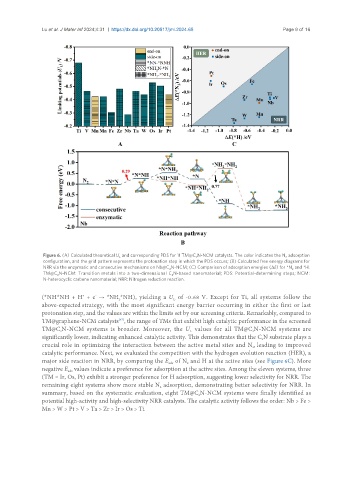
                Figure 6. (A) Calculated theoretical U  and corresponding PDS for 11 TM@C N-NCM catalysts. The color indicates the N  adsorption
                                         L                         2                             2
                configuration, and the grid pattern represents the protonation step in which the PDS occurs; (B) Calculated free energy diagrams for
                NRR via the enzymatic and consecutive mechanisms on Nb@C N-NCM; (C) Comparison of adsorption energies (ΔE) for *N  and *H.
                                                          2                                        2
                TM@C N-NCM: Transition metals into a two-dimensional C N-based nanomaterial; PDS: Potential-determining steps; NCM:
                                                           2
                    2
                N-heterocyclic carbene nanomaterial; NRR: Nitrogen reduction reaction.
               (*NH*NH + H  + e   → *NH *NH), yielding a U  of -0.68 V. Except for Ti, all systems follow the
                             +
                                 -
                                         2
                                                           L
               above-expected strategy, with the most significant energy barrier occurring in either the first or last
               protonation step, and the values are within the limits set by our screening criteria. Remarkably, compared to
                                         [47]
               TM@graphene-NCM catalysts , the range of TMs that exhibit high catalytic performance in the screened
               TM@C N-NCM systems is broader. Moreover, the U  values for all TM@C N-NCM systems are
                     2
                                                                                      2
                                                                 L
               significantly lower, indicating enhanced catalytic activity. This demonstrates that the C N substrate plays a
                                                                                         2
               crucial role in optimizing the interaction between the active metal sites and N , leading to improved
                                                                                      2
               catalytic performance. Next, we evaluated the competition with the hydrogen evolution reaction (HER), a
               major side reaction in NRR, by comparing the E  of N  and H at the active sites (see Figure 6C). More
                                                                2
                                                          ads
               negative E  values indicate a preference for adsorption at the active sites. Among the eleven systems, three
                        ads
               (TM = Ir, Os, Pt) exhibit a stronger preference for H adsorption, suggesting lower selectivity for NRR. The
               remaining eight systems show more stable N  adsorption, demonstrating better selectivity for NRR. In
                                                       2
               summary, based on the systematic evaluation, eight TM@C N-NCM systems were finally identified as
                                                                    2
               potential high-activity and high-selectivity NRR catalysts. The catalytic activity follows the order: Nb > Fe >
               Mn > W > Pt > V > Ta > Zr > Ir > Os > Ti.

