


Page 32 - Read Online
P. 32
Lu et al. J Mater Inf 2024;4:31  https://dx.doi.org/10.20517/jmi.2024.65         Page 5 of 16


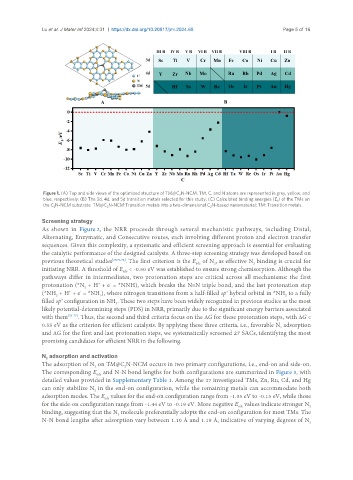
                Figure 1. (A) Top and side views of the optimized structure of TM@C N-NCM. TM, C, and N atoms are represented in grey, yellow, and
                                                             2
                blue, respectively; (B) The 3d, 4d, and 5d transition metals selected for this study; (C) Calculated binding energies (E ) of the TMs on
                                                                                              b
                the C N-NCM substrate. TM@C N-NCM:Transition metals into a two-dimensional C N-based nanomaterial; TM: Transition metals.
                   2
                                     2
                                                                        2
               Screening strategy
               As shown in Figure 2, the NRR proceeds through several mechanistic pathways, including Distal,
               Alternating, Enzymatic, and Consecutive routes, each involving different proton and electron transfer
               sequences. Given this complexity, a systematic and efficient screening approach is essential for evaluating
               the catalytic performance of the designed catalysts. A three-step screening strategy was developed based on
               previous theoretical studies [38,71,72] . The first criterion is the E  of N , as effective N  binding is crucial for
                                                                                      2
                                                                   ads
                                                                         2
               initiating NRR. A threshold of E  < -0.50 eV was established to ensure strong chemisorption. Although the
                                          ads
               pathways differ in intermediates, two protonation steps are critical across all mechanisms: the first
               protonation (*N  + H  + e  = *NNH), which breaks the N≡N triple bond, and the last protonation step
                                  +
                                      -
                              2
                            -
               (*NH  + H  + e  = *NH ), where nitrogen transitions from a half-filled sp  hybrid orbital in *NH  to a fully
                        +
                                                                             3
                                                                                                 2
                                   3
                    2
               filled sp  configuration in NH . These two steps have been widely recognized in previous studies as the most
                      3
                                        3
               likely potential-determining steps (PDS) in NRR, primarily due to the significant energy barriers associated
               with them [73-77] . Thus, the second and third criteria focus on the ΔG for these protonation steps, with ΔG <
               0.55 eV as the criterion for efficient catalysis. By applying these three criteria, i.e., favorable N  adsorption
                                                                                               2
               and ΔG for the first and last protonation steps, we systematically screened 27 SACs, identifying the most
               promising candidates for efficient NRR in the following.
               N  adsorption and activation
                 2
               The adsorption of N  on TM@C N-NCM occurs in two primary configurations, i.e., end-on and side-on.
                                 2
                                           2
               The corresponding E  and N-N bond lengths for both configurations are summarized in Figure 3, with
                                  ads
               detailed values provided in Supplementary Table 1. Among the 27 investigated TMs, Zn, Ru, Cd, and Hg
               can only stabilize N  in the end-on configuration, while the remaining metals can accommodate both
                                 2
               adsorption modes. The E  values for the end-on configuration range from -1.35 eV to -0.15 eV, while those
                                    ads
               for the side-on configuration range from -1.44 eV to -0.19 eV. More negative E  values indicate stronger N
                                                                                                         2
                                                                                 ads
               binding, suggesting that the N  molecule preferentially adopts the end-on configuration for most TMs. The
                                         2
               N-N bond lengths after adsorption vary between 1.10 Å and 1.19 Å, indicative of varying degrees of N
                                                                                                         2

