


Page 39 - Read Online
P. 39
Page 8 of 14                          Zhang et al. J Mater Inf 2024;4:1  https://dx.doi.org/10.20517/jmi.2023.34


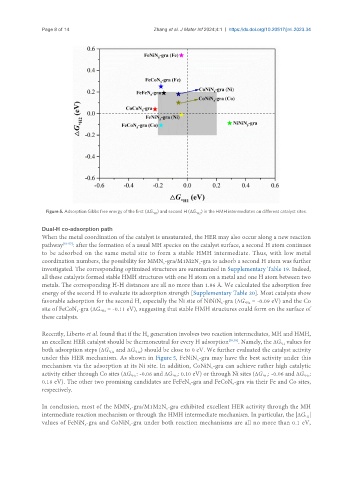
                 Figure 5. Adsorption Gibbs free energy of the first (ΔG ) and second H (ΔG  ) in the HMH intermediates on different catalyst sites.
                                                     *H1           *H2

               Dual-H co-adsorption path
               When the metal coordination of the catalyst is unsaturated, the HER may also occur along a new reaction
               pathway [52-57] : after the formation of a usual MH species on the catalyst surface, a second H atom continues
               to be adsorbed on the same metal site to form a stable HMH intermediate. Thus, with low metal
               coordination numbers, the possibility for MMN -gra/M1M2N -gra to adsorb a second H atom was further
                                                        5
                                                                    5
               investigated. The corresponding optimized structures are summarized in Supplementary Table 19. Indeed,
               all these catalysts formed stable HMH structures with one H atom on a metal and one H atom between two
               metals. The corresponding H-H distances are all no more than 1.86 Å. We calculated the adsorption free
               energy of the second H to evaluate its adsorption strength [Supplementary Table 20]. Most catalysts show
               favorable adsorption for the second H, especially the Ni site of NiNiN -gra (ΔG  = -0.09 eV) and the Co
                                                                                   *H2
                                                                            5
               site of FeCoN -gra (ΔG  = -0.11 eV), suggesting that stable HMH structures could form on the surface of
                           5
                                   *H2
               these catalysts.
               Recently, Liberto et al. found that if the H  generation involves two reaction intermediates, MH and HMH,
                                                   2
               an excellent HER catalyst should be thermoneutral for every H adsorption [58,59] . Namely, the ΔG  values for
                                                                                                *H
               both adsorption steps (ΔG  and ΔG ) should be close to 0 eV. We further evaluated the catalyst activity
                                      *H1
                                               *H2
               under this HER mechanism. As shown in Figure 5, FeNiN -gra may have the best activity under this
                                                                   5
               mechanism via the adsorption at its Ni site. In addition, CoNiN -gra can achieve rather high catalytic
                                                                        5
               activity either through Co sites (ΔG : -0.06 and ΔG : 0.10 eV) or through Ni sites (ΔG : -0.06 and ΔG :
                                                           *H2
                                             *H1
                                                                                          *H1
                                                                                                       *H2
               0.18 eV). The other two promising candidates are FeFeN -gra and FeCoN -gra via their Fe and Co sites,
                                                                               5
                                                                 5
               respectively.
               In conclusion, most of the MMN -gra/M1M2N -gra exhibited excellent HER activity through the MH
                                             5
                                                         5
               intermediate reaction mechanism or through the HMH intermediate mechanism. In particular, the |ΔG |
                                                                                                        *H
               values of FeNiN -gra and CoNiN -gra under both reaction mechanisms are all no more than 0.1 eV,
                                             5
                              5

