


Page 34 - Read Online
P. 34
Zhang et al. J Mater Inf 2024;4:1  https://dx.doi.org/10.20517/jmi.2023.34       Page 3 of 14

               catalysts were then proposed. Finally, in-depth electronic structure analyses revealed the activity origins of
               the catalysts to provide a theoretical guide for the rational design of related catalytic materials.

               COMPUTATIONAL METHODS
               DFT calculations considering spin polarization were carried out by using the Vienna ab initio simulation
                             [41]
                                                                [42]
               package (VASP) . The Perdew-Burke-Ernzerhof (PBE)  functional and the projector augmented wave
               (PAW) method are used. The dispersion interactions during adsorption were considered by using the
               popular Grimme’s DFT-D3 correction method . The convergence thresholds are 10  eV and 0.02 eV/Å for
                                                                                       -5
                                                       [43]
               the energy and force, respectively, and the cutoff energy for the plane wave basis set is 500 eV. A vacuum
               space of 15 Å was applied along the z-direction to avoid the interactions between slabs. A 2 × 2 × 1
               Monkhorst-Pack k-point mesh was used because the cell is as large as 17.22 Å × 17.22 Å × 15.04 Å. All these
               parameters have been carefully tested in our recent work . All the results were visualized with the aid of
                                                                [44]
                                [45]
               the VESTA software .
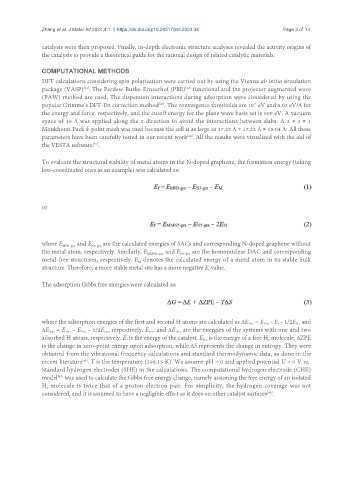
               To evaluate the structural stability of metal atoms in the N-doped graphene, the formation energy (taking
               low-coordinated ones as an example) was calculated as:


               or


               where E MN3-gra  and E N3-gra  are the calculated energies of SACs and corresponding N-doped graphene without
               the metal atom, respectively. Similarly, E MMN5-gra  and E N5-gra  are the homonuclear DAC and corresponding
               metal-free structures, respectively. E  denotes the calculated energy of a metal atom in its stable bulk
                                                M
               structure. Therefore, a more stable metal site has a more negative E value.
                                                                       f
               The adsorption Gibbs free energies were calculated as:


               where the adsorption energies of the first and second H atoms are calculated as ΔE  = E  - E  - 1/2E  and
                                                                                     *H1
                                                                                                     H2
                                                                                               *
                                                                                          *H1
               ΔE  = E  - E  - 1/2E , respectively. E  and ΔE  are the energies of the systems with one and two
                                    H2
                                                   *H1
                                                            *H2
                  *H2
                            *H1
                       *H2
               adsorbed H atoms, respectively. E  is the energy of the catalyst. E  is the energy of a free H  molecule. ΔZPE
                                                                     H2
                                                                                           2
                                            *
               is the change in zero-point energy upon adsorption, while ΔS represents the change in entropy. They were
               obtained from the vibrational frequency calculations and standard thermodynamic data, as done in the
               recent literature . T is the temperature (298.15 K). We assume pH = 0 and applied potential U = 0 V vs.
                             [46]
               Standard hydrogen electrodes (SHE) in the calculations. The computational hydrogen electrode (CHE)
               model  was used to calculate the Gibbs free energy change, namely assuming the free energy of an isolated
                    [47]
               H  molecule is twice that of a proton-electron pair. For simplicity, the hydrogen coverage was not
                 2
               considered, and it is assumed to have a negligible effect as it does on other catalyst surfaces .
                                                                                           [46]

