


Page 36 - Read Online
P. 36
Zhang et al. J Mater Inf 2024;4:1  https://dx.doi.org/10.20517/jmi.2023.34       Page 5 of 14


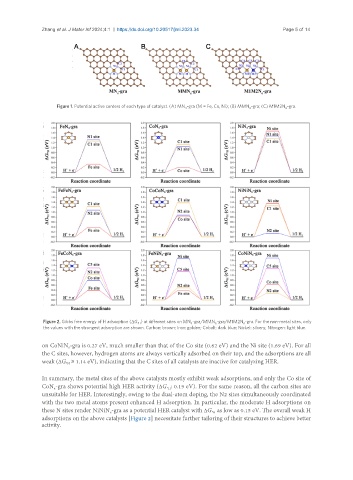
                    Figure 1. Potential active centers of each type of catalyst. (A) MN -gra (M = Fe, Co, Ni); (B) MMN -gra; (C) M1M2N -gra.
                                                               4
                                                                                     6
                                                                                                 6


                Figure 2. Gibbs free energy of H adsorption (ΔG ) at different sites on MN -gra/MMN -gra/M1M2N -gra. For the non-metal sites, only
                                                                         6
                                               *H
                                                                 4
                                                                                   6
                the values with the strongest adsorption are shown. Carbon: brown; Iron: golden; Cobalt: dark blue; Nickel: silvery; Nitrogen: light blue.
               on CoNiN -gra is 0.27 eV, much smaller than that of the Co site (0.62 eV) and the Ni site (1.69 eV). For all
                        6
               the C sites, however, hydrogen atoms are always vertically adsorbed on their top, and the adsorptions are all
               weak (ΔG  ≥ 1.14 eV), indicating that the C sites of all catalysts are inactive for catalyzing HER.
                       *H
               In summary, the metal sites of the above catalysts mostly exhibit weak adsorptions, and only the Co site of
               CoN -gra shows potential high HER activity (ΔG : 0.19 eV). For the same reason, all the carbon sites are
                                                         *H
                   4
               unsuitable for HER. Interestingly, owing to the dual-atom doping, the N2 sites simultaneously coordinated
               with the two metal atoms present enhanced H adsorption. In particular, the moderate H adsorptions on
               these N sites render NiNiN -gra as a potential HER catalyst with ΔG  as low as 0.15 eV. The overall weak H
                                      6
                                                                        *H
               adsorptions on the above catalysts [Figure 2] necessitate further tailoring of their structures to achieve better
               activity.

