


Page 38 - Read Online
P. 38
Zhang et al. J Mater Inf 2024;4:1  https://dx.doi.org/10.20517/jmi.2023.34       Page 7 of 14


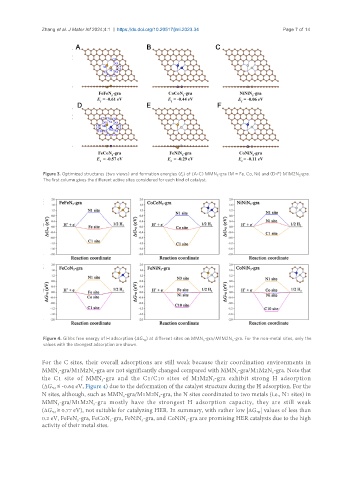
                Figure 3. Optimized structures (two views) and formation energies (E ) of (A-C) MMN -gra (M = Fe, Co, Ni) and (D-F) M1M2N -gra.
                                                               f          5                           5
                The first column gives the different active sites considered for each kind of catalyst.


                Figure 4. Gibbs free energy of H adsorption (ΔG ) at different sites on MMN -gra/M1M2N -gra. For the non-metal sites, only the
                                                 *H                  5         5
                values with the strongest adsorption are shown.
               For the C sites, their overall adsorptions are still weak because their coordination environments in
               MMN -gra/M1M2N -gra are not significantly changed compared with MMN -gra/M1M2N -gra. Note that
                                                                                             6
                                5
                    5
                                                                                 6
               the  C1  site  of  MMN -gra  and  the  C1/C10  sites  of  M1M2N -gra  exhibit  strong  H  adsorption
                                   5
                                                                         5
               (ΔG  ≤ -0.64 eV, Figure 4) due to the deformation of the catalyst structure during the H adsorption. For the
                  *H
               N sites, although, such as MMN -gra/M1M2N -gra, the N sites coordinated to two metals (i.e., N1 sites) in
                                           6
                                                       6
               MMN -gra/M1M2N -gra  mostly  have  the  strongest  H  adsorption  capacity,  they  are  still  weak
                    5
                                 5
               (ΔG  ≥ 0.77 eV), not suitable for catalyzing HER. In summary, with rather low |ΔG | values of less than
                  *H
                                                                                       *H
               0.2 eV, FeFeN -gra, FeCoN -gra, FeNiN -gra, and CoNiN -gra are promising HER catalysts due to the high
                                                                5
                           5
                                      5
                                                 5
               activity of their metal sites.

