


Page 105 - Read Online
P. 105
Wu et al. J. Mater. Inf. 2025, 5, 15  https://dx.doi.org/10.20517/jmi.2024.67    Page 9 of 15

               electron behavior in metal electrodes is crucial for energy storage and conversion devices (batteries,
               capacitors, and electrocatalysts). Grisafi et al. introduced an equivariant kernel-based method that combines
               long-range interactions to accurately predict electron density responses in metal electrodes under various
               electric field conditions, achieving quantum-level accuracy at a fraction of the computational cost of
               traditional methods .
                                [87]
               Equivariant GNN-based models
               The GNNs are usually E(3)-invariant models considering the unchanged properties under the Euclidean
               group of transformations, which includes translations, rotations, and reflections in three-dimensional space.
               However, the interactions between molecules and materials are far beyond this. Unlike invariance,
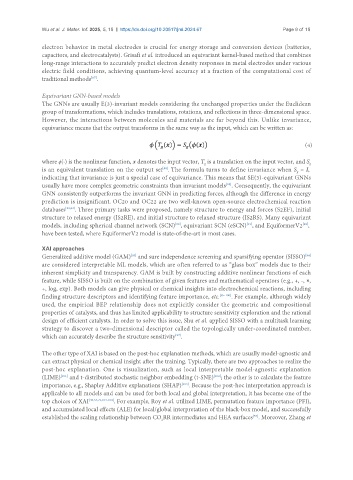
               equivariance means that the output transforms in the same way as the input, which can be written as:


                                                                                                        (4)

               where ϕ(·) is the nonlinear function, x denotes the input vector, T  is a translation on the input vector, and S
                                                                      g
                                                                                                         g
                                                        [88]
               is an equivalent translation on the output set . The formula turns to define invariance when S  = I,
                                                                                                     g
               indicating that invariance is just a special case of equivariance. This means that SE(3)-equivariant GNNs
                                                                             [89]
               usually have more complex geometric constraints than invariant models . Consequently, the equivariant
               GNN consistently outperforms the invariant GNN in predicting forces, although the difference in energy
               prediction is insignificant. OC20 and OC22 are two well-known open-source electrochemical reaction
               databases [23,24] . Three primary tasks were proposed, namely structure to energy and forces (S2EF), initial
               structure to relaxed energy (IS2RE), and initial structure to relaxed structure (IS2RS). Many equivariant
                                                                                                       [92]
               models, including spherical channel network (SCN) , equivariant SCN (eSCN) , and EquiformerV2 ,
                                                            [90]
                                                                                    [91]
               have been tested, where EquiformerV2 model is state-of-the-art in most cases.
               XAI approaches
               Generalized additive model (GAM)  and sure independence screening and sparsifying operator (SISSO)
                                                                                                        [94]
                                             [93]
               are considered interpretable ML models, which are often referred to as “glass box” models due to their
               inherent simplicity and transparency. GAM is built by constructing additive nonlinear functions of each
               feature, while SISSO is built on the combination of given features and mathematical operators (e.g., +, -, ×,
               ÷, log, exp). Both models can give physical or chemical insights into electrochemical reactions, including
               finding structure descriptors and identifying feature importance, etc. [95-100] . For example, although widely
               used, the empirical BEP relationship does not explicitly consider the geometric and compositional
               properties of catalysts, and thus has limited applicability to structure sensitivity exploration and the rational
               design of efficient catalysts. In order to solve this issue, Shu et al. applied SISSO with a multitask learning
               strategy to discover a two-dimensional descriptor called the topologically under-coordinated number,
                                                            [97]
               which can accurately describe the structure sensitivity .

               The other type of XAI is based on the post-hoc explanation methods, which are usually model-agnostic and
               can extract physical or chemical insight after the training. Typically, there are two approaches to realize the
               post-hoc explanation. One is visualization, such as local interpretable model-agnostic explanation
                                                                         [102]
               (LIME)  and t-distributed stochastic neighbor embedding (t-SNE) ; the other is to calculate the feature
                      [101]
               importance, e.g., Shapley Additive explanations (SHAP) . Because the post-hoc interpretation approach is
                                                              [103]
               applicable to all models and can be used for both local and global interpretation, it has become one of the
               top choices of XAI [46,54,75,104-108] . For example, Roy et al. utilized LIME, permutation feature importance (PFI),
               and accumulated local effects (ALE) for local/global interpretation of the black-box model, and successfully
                                                                                      [53]
               established the scaling relationship between CO RR intermediates and HEA surfaces . Moreover, Zhang et
                                                       2

