


Page 81 - Read Online
P. 81
Page 12 of 22                                                    Ma et al. Hepatoma Res. 2026;12:43


                                                                       Integrating the
                                                                       multidimensional  To integrate the
                                                                       molecular     copy number,
                                                           Whole-genome              mutation, and
                                              The number of            characteristics of
                                              mtDNA        sequencing,  plasma-free  fragment omics
                       HDR prediction         mutations,   Capture-based  mitochondrial DNA  characteristics of
                       model and HPR  2025    mtDNA copy   mtDNA       provides a highly  plasma-free  OS and PFS
                       prediction model [55]               sequencing, Cox           mitochondrial DNA
                                              number, HPP              sensitive, real-time,
                                              score        proportional  and noninvasive  for real-time
                                                           hazards model             monitoring of TACE
                                                                       prognostic
                                                                       monitoring tool for  efficacy and
               Frontier                                                liquid biopsy  prognosis
               and
               future                                                                The key variables
               models                                                  Excellent     are selected
                                              Intratumoral             classification  through recursive
                                                                                     feature elimination,
                                              artery, Corona  Recursive feature feature processing  and the
                                              enhancement,  elimination,  ability and strong  interpretability of
                                              DCP, fat in mass,  ensemble  anti-overfitting
                       CatBoost model [56]  2025                                     model prediction is  ASP
                                              INR, Neu, tumor  learning  performance can  realized by using
                                              number, ALT, BMI, (gradient  effectively integrate  SHAP, which
                                              necrosis or severe  boosting), SHAP  multi-source  ultimately serves
                                              ischemia, AFP            clinical and image  the risk
                                                                       data
                                                                                     stratification of
                                                                                     patients
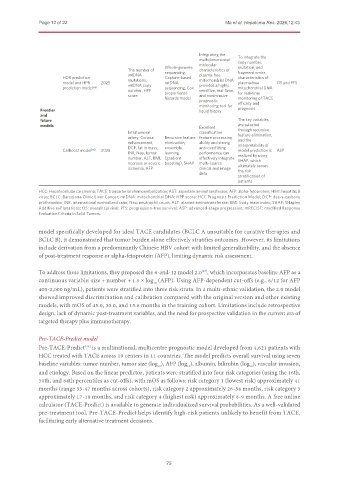
               HCC: Hepatocellular carcinoma; TACE: transarterial chemoembolization; AST: aspartate aminotransferase; AFP: alpha-fetoprotein; HBV: hepatitis B
               virus; BCLC: Barcelona Clinic Liver Cancer; mtDNA: mitochondrial DNA; HPP score: HCC Prognosis Prediction Model; DCP: des-γ-carboxy
               prothrombin; INR: international normalized ratio; Neu: neutrophil count; ALT: alanine aminotransferase; BMI: body mass index; SHAP: SHapley
               Additive exPlanations; OS: overall survival; PFS: progression-free survival; ASP: advanced-stage progression; mRECIST: modified Response
               Evaluation Criteria in Solid Tumors.

               model specifically developed for ideal TACE candidates (BCLC A unsuitable for curative therapies and
               BCLC B), it demonstrated that tumor burden alone effectively stratifies outcomes. However, its limitations
               include derivation from a predominantly Chinese HBV cohort with limited generalizability, and the absence
               of post-treatment response or alpha-fetoprotein (AFP), limiting dynamic risk assessment.


               To address these limitations, they proposed the 6-and-12 model 2.0 , which incorporates baseline AFP as a
                                                                        [47]
               continuous variable: size + number + 1.5 × log  (AFP). Using AFP-dependent cut-offs (e.g., 6/12 for AFP
                                                       10
               400-2,000 ng/mL), patients were stratified into three risk strata. In a multi-ethnic validation, the 2.0 model
               showed improved discrimination and calibration compared with the original version and other existing
               models, with mOS of 45.0, 30.0, and 15.8 months in the training cohort. Limitations include retrospective
               design, lack of dynamic post-treatment variables, and the need for prospective validation in the current era of
               targeted therapy plus immunotherapy.


               Pre-TACE-Predict model
               Pre-TACE-Predict  is a multinational, multicentre prognostic model developed from 4,621 patients with
                               [48]
               HCC treated with TACE across 19 centers in 11 countries. The model predicts overall survival using seven
               baseline variables: tumor number, tumor size (log ), AFP (log ), albumin, bilirubin (log ), vascular invasion,
                                                                   10
                                                        10
                                                                                         10
               and etiology. Based on the linear predictor, patients were stratified into four risk categories (using the 16th,
               50th, and 84th percentiles as cut-offs), with mOS as follows: risk category 1 (lowest risk) approximately 41
               months (range 35-47 months across cohorts), risk category 2 approximately 26-34 months, risk category 3
               approximately 17-18 months, and risk category 4 (highest risk) approximately 8-9 months. A free online
               calculator (TACE-Predict) is available to generate individualized survival probabilities. As a well-validated
               pre-treatment tool, Pre-TACE-Predict helps identify high-risk patients unlikely to benefit from TACE,
               facilitating early alternative treatment decisions.

