


Page 254 - Read Online
P. 254
Page 24 of 33          Girase et al. Energy Mater. 2025, 5, 500132  https://dx.doi.org/10.20517/energymater.2025.14


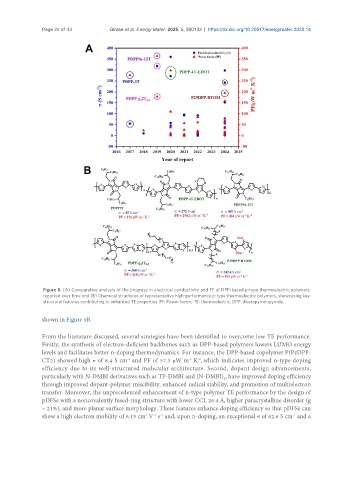
                Figure 8. (A) Comparative analysis of the progress in electrical conductivity and PF of DPP-based p-type thermoelectric polymers
                reported over time and (B) Chemical structures of representative high-performance p-type thermoelectric polymers, showcasing key
                structural features contributing to enhanced TE properties. PF: Power factor; TE: thermoelectric; DPP: diketopyrrolopyrrole.

               shown in Figure 9B.


               From the literature discussed, several strategies have been identified to overcome low TE performance.
               Firstly, the synthesis of electron-deficient backbones such as DPP-based polymers lowers LUMO energy
               levels and facilitates better n-doping thermodynamics. For instance, the DPP-based copolymer P(PzDPP-
                                            -1
               CT2) showed high σ of 8.4 S cm  and PF of 57.3 μW m  K , which indicates improved n-type doping
                                                                    -2
                                                                 -1
               efficiency due to its well-structured molecular architecture. Second, dopant design advancements,
               particularly with N-DMBI derivatives such as TP-DMBI and (N-DMBI) , have improved doping efficiency
                                                                            2
               through improved dopant-polymer miscibility, enhanced radical stability, and promotion of multielectron
               transfer. Moreover, the unprecedented enhancement of n-type polymer TE performance by the design of
               pDFSe with a noncovalently fused-ring structure with lower CCL 26.4 Å, higher paracrystalline disorder (g
               = 21%), and more planar surface morphology. These features enhance doping efficiency so that pDFSe can
                                                                                                    -1
               show a high electron mobility of 6.15 cm  V  s  and, upon n-doping, an exceptional σ of 62.6 S cm  and a
                                                     -1 -1
                                                  2

