


Page 255 - Read Online
P. 255
Girase et al. Energy Mater. 2025, 5, 500132  https://dx.doi.org/10.20517/energymater.2025.14  Page 25 of 33


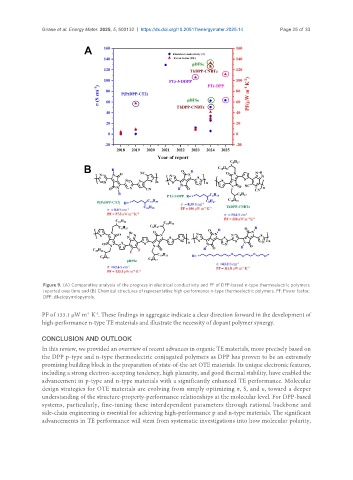
                Figure 9. (A) Comparative analysis of the progress in electrical conductivity and PF of DPP-based n-type thermoelectric polymers
                reported over time and (B) Chemical structures of representative high-performance n-type thermoelectric polymers. PF: Power factor;
                DPP: diketopyrrolopyrrole.

               PF of 133.1 μW m  K . These findings in aggregate indicate a clear direction forward in the development of
                              -1
                                 -2
               high-performance n-type TE materials and illustrate the necessity of dopant polymer synergy.

               CONCLUSION AND OUTLOOK
               In this review, we provided an overview of recent advances in organic TE materials, more precisely based on
               the DPP p-type and n-type thermoelectric conjugated polymers as DPP has proven to be an extremely
               promising building block in the preparation of state-of-the-art OTE materials. Its unique electronic features,
               including a strong electron-accepting tendency, high planarity, and good thermal stability, have enabled the
               advancement in p-type and n-type materials with a significantly enhanced TE performance. Molecular
               design strategies for OTE materials are evolving from simply optimizing σ, S, and κ, toward a deeper
               understanding of the structure-property-performance relationships at the molecular level. For DPP-based
               systems, particularly, fine-tuning these interdependent parameters through rational backbone and
               side-chain engineering is essential for achieving high-performance p and n-type materials. The significant
               advancements in TE performance will stem from systematic investigations into how molecular polarity,

