


Page 250 - Read Online
P. 250
Page 20 of 33          Girase et al. Energy Mater. 2025, 5, 500132  https://dx.doi.org/10.20517/energymater.2025.14


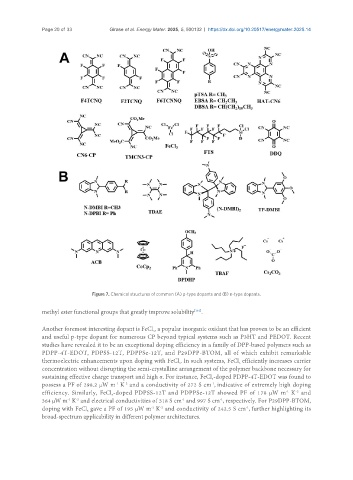
                                Figure 7. Chemical structures of common (A) p-type dopants and (B) n-type dopants.

               methyl ester functional groups that greatly improve solubility .
                                                                  [161]
               Another foremost interesting dopant is FeCl , a popular inorganic oxidant that has proven to be an efficient
                                                     3
               and useful p-type dopant for numerous CP beyond typical systems such as P3HT and PEDOT. Recent
               studies have revealed it to be an exceptional doping efficiency in a family of DPP-based polymers such as
               PDPP-4T-EDOT, PDPSS-12T, PDPPSe-12T, and P29DPP-BTOM, all of which exhibit remarkable
               thermoelectric enhancements upon doping with FeCl . In such systems, FeCl  efficiently increases carrier
                                                             3
                                                                                  3
               concentration without disrupting the semi-crystalline arrangement of the polymer backbone necessary for
               sustaining effective charge transport and high σ. For instance, FeCl -doped PDPP-4T-EDOT was found to
                                                                        3
                                        -1
                                           -2
               possess a PF of 298.2 μW m  K  and a conductivity of 272 S cm , indicative of extremely high doping
                                                                        -1
               efficiency. Similarly, FeCl -doped PDPSS-12T and PDPPSe-12T showed PF of 178  μW m  K  and
                                                                                                     -2
                                                                                                 -1
                                       3
                                                              -1
                                                                           -1
                        -1
               364 μW m  K  and electrical conductivities of 318 S cm  and 997 S cm , respectively. For P29DPP-BTOM,
                           -2
               doping with FeCl  gave a PF of 195 μW m  K  and conductivity of 242.5 S cm , further highlighting its
                                                                                    -1
                                                       -2
                                                    -1
                              3
               broad-spectrum applicability in different polymer architectures.

