


Page 249 - Read Online
P. 249
Girase et al. Energy Mater. 2025, 5, 500132  https://dx.doi.org/10.20517/energymater.2025.14  Page 19 of 33


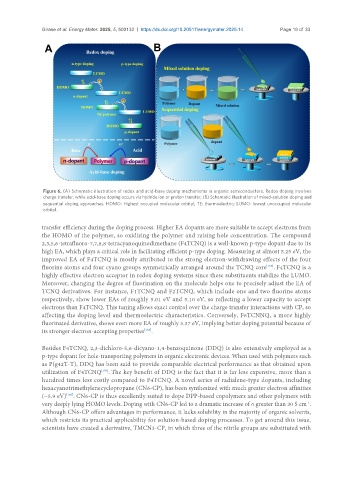
                Figure 6. (A) Schematic illustration of redox and acid-base doping mechanisms in organic semiconductors. Redox doping involves
                charge transfer, while acid-base doping occurs via hydride ion or proton transfer; (B) Schematic illustration of mixed-solution doping and
                sequential doping approaches. HOMO: Highest occupied molecular orbital; TE: thermoelectric; LUMO: lowest unoccupied molecular
                orbital.

               transfer efficiency during the doping process. Higher EA dopants are more suitable to accept electrons from
               the HOMO of the polymer, so oxidizing the polymer and raising hole concentration. The compound
               2,3,5,6-tetrafluoro-7,7,8,8-tetracyanoquinodimethane (F4TCNQ) is a well-known p-type dopant due to its
               high EA, which plays a critical role in facilitating efficient p-type doping. Measuring at almost 5.25 eV, the
               improved EA of F4TCNQ is mostly attributed to the strong electron-withdrawing effects of the four
               fluorine atoms and four cyano groups symmetrically arranged around the TCNQ core . F4TCNQ is a
                                                                                           [157]
               highly effective electron acceptor in redox doping systems since these substituents stabilize the LUMO.
               Moreover, changing the degree of fluorination on the molecule helps one to precisely adjust the EA of
               TCNQ derivatives. For instance, F1TCNQ and F2TCNQ, which include one and two fluorine atoms
               respectively, show lower EAs of roughly 5.01 eV and 5.10 eV, so reflecting a lower capacity to accept
               electrons than F4TCNQ. This tuning allows exact control over the charge transfer interactions with CP, so
               affecting the doping level and thermoelectric characteristics. Conversely, F6TCNNQ, a more highly
               fluorinated derivative, shows even more EA of roughly 5.37 eV, implying better doping potential because of
               its stronger electron-accepting properties .
                                                  [158]
               Besides F4TCNQ, 2,3-dichloro-5,6-dicyano-1,4-benzoquinone (DDQ) is also extensively employed as a
               p-type dopant for hole-transporting polymers in organic electronic devices. When used with polymers such
               as P(g42T-T), DDQ has been said to provide comparable electrical performance as that obtained upon
                                   [159]
               utilization of F4TCNQ . The key benefit of DDQ is the fact that it is far less expensive, more than a
               hundred times less costly compared to F4TCNQ. A novel series of radialene-type dopants, including
               hexacyanotrimethylenecyclopropane (CN6-CP), has been synthesized with much greater electron affinities
                       [160]
               (~5.9 eV) . CN6-CP is thus excellently suited to dope DPP-based copolymers and other polymers with
               very deeply lying HOMO levels. Doping with CN6-CP led to a dramatic increase of σ greater than 30 S cm .
                                                                                                        -1
               Although CN6-CP offers advantages in performance, it lacks solubility in the majority of organic solvents,
               which restricts its practical applicability for solution-based doping processes. To get around this issue,
               scientists have created a derivative, TMCN3-CP, in which three of the nitrile groups are substituted with

