


Page 158 - Read Online
P. 158
Martin-Gonzalez et al. Energy Mater. 2025, 5, 500121  https://dx.doi.org/10.20517/energymater.2025.32  Page 13 of 35


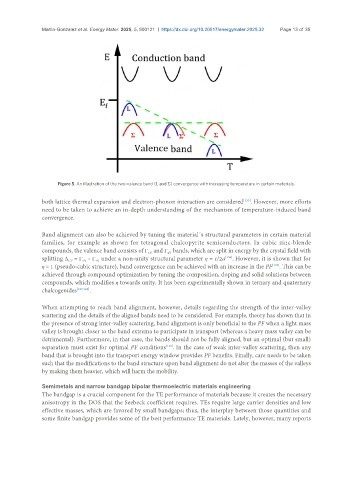
                     Figure 5. An illustration of the two-valence band (L and Σ) convergence with increasing temperature in certain materials.


                                                                                   [135]
               both lattice thermal expansion and electron-phonon interaction are considered . However, more efforts
               need to be taken to achieve an in-depth understanding of the mechanism of temperature-induced band
               convergence.

               Band alignment can also be achieved by tuning the material´s structural parameters in certain material
               families, for example as shown for tetragonal chalcopyrite semiconductors. In cubic zinc-blende
               compounds, the valence band consists of Γ  and Γ  bands, which are split in energy by the crystal field with
                                                         4V
                                                   5V
                                                                             [136]
               splitting Δ  = Γ  - Γ  under a non-unity structural parameter η = c/2a . However, it is shown that for
                             5V
                        CF
                                 4V
                                                                                             [137]
               η ≈ 1 (pseudo-cubic structure), band convergence can be achieved with an increase in the PF . This can be
               achieved through compound optimization by tuning the composition, doping and solid solutions between
               compounds, which modifies η towards unity. It has been experimentally shown in ternary and quaternary
               chalcogenides [137,138] .
               When attempting to reach band alignment, however, details regarding the strength of the inter-valley
               scattering and the details of the aligned bands need to be considered. For example, theory has shown that in
               the presence of strong inter-valley scattering, band alignment is only beneficial to the PF when a light mass
               valley is brought closer to the band extrema to participate in transport (whereas a heavy mass valley can be
               detrimental). Furthermore, in that case, the bands should not be fully aligned, but an optimal (but small)
                                                         [120]
               separation must exist for optimal PF conditions . In the case of weak inter-valley scattering, then any
               band that is brought into the transport energy window provides PF benefits. Finally, care needs to be taken
               such that the modifications to the band structure upon band alignment do not alter the masses of the valleys
               by making them heavier, which will harm the mobility.


               Semimetals and narrow bandgap bipolar thermoelectric materials engineering
               The bandgap is a crucial component for the TE performance of materials because it creates the necessary
               anisotropy in the DOS that the Seebeck coefficient requires. TEs require large carrier densities and low
               effective masses, which are favored by small bandgaps; thus, the interplay between those quantities and
               some finite bandgap provides some of the best performance TE materials. Lately, however, many reports

