


Page 157 - Read Online
P. 157
Page 12 of 35   Martin-Gonzalez et al. Energy Mater. 2025, 5, 500121  https://dx.doi.org/10.20517/energymater.2025.32


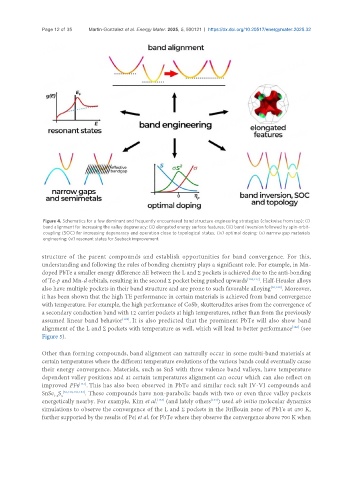
                Figure 4. Schematics for a few dominant and frequently encountered band structure engineering strategies (clockwise from top): (i)
                band alignment for increasing the valley degeneracy; (ii) elongated energy surface features; (iii) band inversion followed by spin-orbit-
                coupling (SOC) for increasing degeneracy and operation close to topological states; (iv) optimal doping; (v) narrow gap materials
                engineering; (vi) resonant states for Seebeck improvement.

               structure of the parent compounds and establish opportunities for band convergence. For this,
               understanding and following the rules of bonding chemistry plays a significant role. For example, in Mn-
               doped PbTe a smaller energy difference ΔE between the L and Σ pockets is achieved due to the anti-bonding
               of Te-p and Mn-d orbitals, resulting in the second Σ pocket being pushed upwards [126,127] . Half-Heusler alloys
               also have multiple pockets in their band structure and are prone to such favorable alloying [30,128] . Moreover,
               it has been shown that the high TE performance in certain materials is achieved from band convergence
               with temperature. For example, the high performance of CoSb  skutterudites arises from the convergence of
                                                                    3
               a secondary conduction band with 12 carrier pockets at high temperatures, rather than from the previously
                                          [129]
               assumed linear band behavior . It is also predicted that the prominent PbTe will also show band
               alignment of the L and Σ pockets with temperature as well, which will lead to better performance  (see
                                                                                                   [130]
               Figure 5).

               Other than forming compounds, band alignment can naturally occur in some multi-band materials at
               certain temperatures where the different temperature evolutions of the various bands could eventually cause
               their energy convergence. Materials, such as SnS with three valence band valleys, have temperature
               dependent valley positions and at certain temperatures alignment can occur which can also reflect on
                            [131]
               improved PFs . This has also been observed in PbTe and similar rock salt IV-VI compounds and
               SnSe S  [32,128,131,132] . These compounds have non-parabolic bands with two or even three valley pockets
                   1-x x
                                                                        [134]
                                                      [133]
               energetically nearby. For example, Kim et al.  (and lately others ) used ab initio molecular dynamics
               simulations to observe the convergence of the L and Σ pockets in the Brillouin zone of PbTe at 450 K,
               further supported by the results of Pei et al. for PbTe where they observe the convergence above 700 K when

