


Page 97 - Read Online
P. 97
Page 12 of 22                                                Song et al. Energy Mater. 2026, 6, 600019


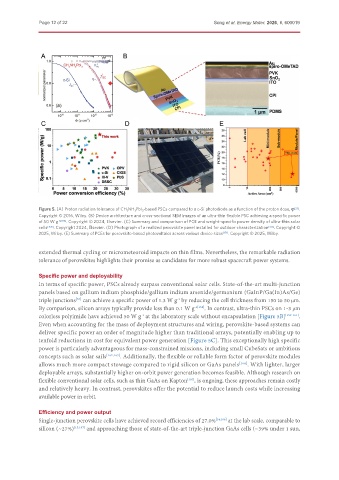
               Figure 5. (A) Proton radiation tolerance of CH 3 NH 3 PbI 3 -based PSCs compared to a c-Si photodiode as a function of the proton dose, j .
                                                                                                        [23]
               Copyright © 2016, Wiley. (B) Device architecture and cross-sectional SEM images of an ultra-thin flexible PSC achieving a specific power
               of 50 W g -1[159] . Copyright © 2024, Elsevier. (C) Summary and comparison of PCE and weight-specific power density of ultra-thin solar
               cells  [159] . Copyright 2024, Elsevier. (D) Photograph of a realized perovskite panel installed for outdoor characterization  [171] . Copyright ©
               2025, Wiley. (E) Summary of PCEs for perovskite-based photovoltaics across various device sizes [171] . Copyright © 2025, Wiley.


               extended thermal cycling or micrometeoroid impacts on thin films. Nevertheless, the remarkable radiation
               tolerance of perovskites highlights their promise as candidates for more robust spacecraft power systems.


               Specific power and deployability
               In terms of specific power, PSCs already surpass conventional solar cells. State-of-the-art multi-junction
               panels based on gallium indium phosphide/gallium indium arsenide/germanium (GaInP/Ga(In)As/Ge)
               triple junctions  can achieve a specific power of 1.3 W g  by reducing the cell thickness from 150 to 50 μm.
                                                               -1
                            [57]
               By comparison, silicon arrays typically provide less than 0.1 W g -1[158] . In contrast, ultra-thin PSCs on 1-3 μm
               colorless polyimide have achieved 50 W g  at the laboratory scale without encapsulation [Figure 5B] [159-161] .
                                                   -1
               Even when accounting for the mass of deployment structures and wiring, perovskite-based systems can
               deliver specific power an order of magnitude higher than traditional arrays, potentially enabling up to
               tenfold reductions in cost for equivalent power generation [Figure 5C]. This exceptionally high specific
               power is particularly advantageous for mass-constrained missions, including small CubeSats or ambitious
               concepts such as solar sails [162,163] . Additionally, the flexible or rollable form factor of perovskite modules
               allows much more compact stowage compared to rigid silicon or GaAs panels [164] . With lighter, larger
               deployable arrays, substantially higher on-orbit power generation becomes feasible. Although research on
               flexible conventional solar cells, such as thin GaAs on Kapton , is ongoing, these approaches remain costly
                                                                   [165]
               and relatively heavy. In contrast, perovskites offer the potential to reduce launch costs while increasing
               available power in orbit.


               Efficiency and power output
               Single-junction perovskite cells have achieved record efficiencies of 27.0% [14,166]  at the lab scale, comparable to
               silicon (~27%) [15,167]  and approaching those of state-of-the-art triple-junction GaAs cells (~39% under 1 sun,

