


Page 99 - Read Online
P. 99
Page 14 of 22                                                Song et al. Energy Mater. 2026, 6, 600019


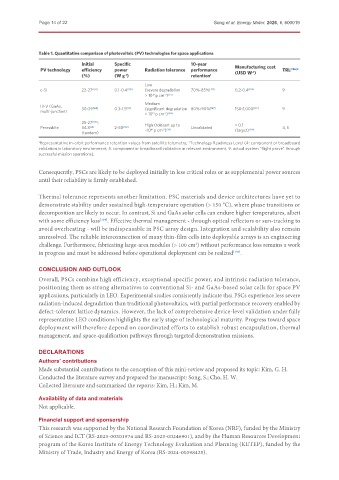
               Table 1. Quantitative comparison of photovoltaic (PV) technologies for space applications
                              Initial    Specific                   10-year
               PV technology  efficiency  power     Radiation tolerance  performance  Manufacturing cost  TRL [186]2
                                                                                    (USD W )
                                                                                          -1
                              (%)        (W g )                     retention 1
                                             -1
                                                    Low
               c-Si           22-27 [167]  0.1-0.4 [158]  (severe degradation   70%-85% [157]  0.2-0.4 [174]  9
                                                    > 10  p cm )
                                                       12
                                                           -2 [23]
                                                    Medium
               III-V (GaAs,   30-39 [168]  0.3-1.5 [57]  (significant degradation 80%-90% [157]  150-1,000 [173]  9
               multi-junction)
                                                    > 10  p cm )
                                                           -2 [155]
                                                       13
                              25-27 [166] ;
               Perovskite     34.8 [14]  2-50 [159]  High (tolerant up to  Unvalidated  < 0.1  [176]  4, 5
                                                          -2 [28]
                                                      16
                              (tandem)              ~10  p cm )                     (target)
               1 Representative in-orbit performance retention values from satellite telemetry;  Technology Readiness Level (4: component or breadboard
                                                                   2
               validation in laboratory environment, 5: component or breadboard validation in relevant environment, 9: actual system “flight prove” through
               successful mission operations).
               Consequently, PSCs are likely to be deployed initially in less critical roles or as supplemental power sources
               until their reliability is firmly established.
               Thermal tolerance represents another limitation. PSC materials and device architectures have yet to
               demonstrate stability under sustained high-temperature operation (> 150 °C), where phase transitions or
               decomposition are likely to occur. In contrast, Si and GaAs solar cells can endure higher temperatures, albeit
               with some efficiency loss [184] . Effective thermal management - through optical reflectors or sun-tracking to
               avoid overheating - will be indispensable in PSC array design. Integration and scalability also remain
               unresolved. The reliable interconnection of many thin-film cells into deployable arrays is an engineering
               challenge. Furthermore, fabricating large-area modules (> 100 cm ) without performance loss remains a work
                                                                      2
               in progress and must be addressed before operational deployment can be realized .
                                                                                   [185]
               CONCLUSION AND OUTLOOK
               Overall, PSCs combine high efficiency, exceptional specific power, and intrinsic radiation tolerance,
               positioning them as strong alternatives to conventional Si- and GaAs-based solar cells for space PV
               applications, particularly in LEO. Experimental studies consistently indicate that PSCs experience less severe
               radiation-induced degradation than traditional photovoltaics, with partial performance recovery enabled by
               defect-tolerant lattice dynamics. However, the lack of comprehensive device-level validation under fully
               representative LEO conditions highlights the early stage of technological maturity. Progress toward space
               deployment will therefore depend on coordinated efforts to establish robust encapsulation, thermal
               management, and space-qualification pathways through targeted demonstration missions.


               DECLARATIONS
               Authors’ contributions
               Made substantial contributions to the conception of this mini-review and proposed its topic: Kim, G. H.
               Conducted the literature survey and prepared the manuscript: Song, S.; Cho, H. W.
               Collected literature and summarized the reports: Kim, H.; Kim, M.


               Availability of data and materials
               Not applicable.

               Financial support and sponsorship
               This research was supported by the National Research Foundation of Korea (NRF), funded by the Ministry
               of Science and ICT (RS-2023-00301974 and RS-2023-00246901), and by the Human Resources Development
               program of the Korea Institute of Energy Technology Evaluation and Planning (KETEP), funded by the
               Ministry of Trade, Industry and Energy of Korea (RS-2024-00398425).

