


Page 91 - Read Online
P. 91
Page 6 of 22                                                 Song et al. Energy Mater. 2026, 6, 600019


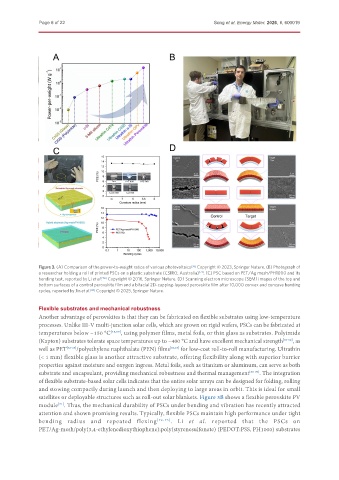
               Figure 3. (A) Comparison of the power-to-weight ratios of various photovoltaics [58]  Copyright © 2023, Springer Nature. (B) Photograph of
               a researcher holding a roll of printed PSCs on a plastic substrate (CSIRO, Australia) . (C) PSC based on PET/Ag mesh/PH1000 and its
                                                                       [71]
               bending test, reported by Li et al. [76]  Copyright © 2016, Springer Nature. (D) Scanning electron microscope (SEM) images of the top and
               bottom surfaces of a control perovskite film and a bifacial 2D-capping-layered perovskite film after 10,000 convex and concave bending
               cycles, reported by Jin et al. [80]  Copyright © 2025, Springer Nature.


               Flexible substrates and mechanical robustness
               Another advantage of perovskites is that they can be fabricated on flexible substrates using low-temperature
               processes. Unlike III-V multi-junction solar cells, which are grown on rigid wafers, PSCs can be fabricated at
               temperatures below ~150 °C [48,59] , using polymer films, metal foils, or thin glass as substrates. Polyimide
               (Kapton) substrates tolerate space temperatures up to ~400 °C and have excellent mechanical strength [60-62] , as
               well as PET [63-65] /polyethylene naphthalate (PEN) films [66,67]  for low-cost roll-to-roll manufacturing. Ultrathin
               (< 1 mm) flexible glass is another attractive substrate, offering flexibility along with superior barrier
               properties against moisture and oxygen ingress. Metal foils, such as titanium or aluminum, can serve as both
               substrate and encapsulant, providing mechanical robustness and thermal management [68-70] . The integration
               of flexible substrate-based solar cells indicates that the entire solar arrays can be designed for folding, rolling
               and stowing compactly during launch and then deploying to large areas in orbit. This is ideal for small
               satellites or deployable structures such as roll-out solar blankets. Figure 3B shows a flexible perovskite PV
               module . Thus, the mechanical durability of PSCs under bending and vibration has recently attracted
                     [71]
               attention and shown promising results. Typically, flexible PSCs maintain high performance under tight
               bending   radius   and   repeated   flexing [72-75] .   Li   et   al.   reported   that   the   PSCs   on
               PET/Ag-mesh/poly(3,4-ethylenedioxythiophene):poly(styrenesulfonate) (PEDOT:PSS, PH1000) substrates

