


Page 33 - Read Online
P. 33
Page 26 of 34                                                Wang et al. Energy Mater. 2026, 6, 600064


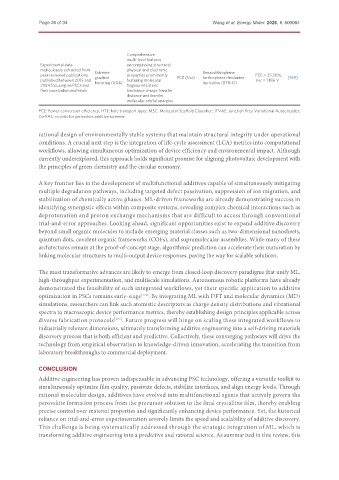
                                              Comprehensive
                                              multi-level features
               Experimental data              encompassing structural
               meticulously extracted from    physical and electronic
               peer reviewed publications  Extreme  properties prominently  Benzodithiophene  PCE = 25.36%,
               published between 2015 and  gradient  featuring molecular  PCE (Voc)  terthiophene rhodanine  Voc = 1.186 V  [169]
               2024 focusing on PSCs and  boosting (XGB)  fingerprints steric  derivative (BTR-Cl)
               their passivation materials    hindrance charge transfer
                                              distance and frontier
                                              molecular orbital energies
               PCE: Power conversion efficiency; HTL: hole transport layer; MSC: Molecular Scaffold Classifier; JTVAE: Junction Tree Variational Autoencoder;
               Co-PAS: co-pilot for perovskite additive screener.

               rational design of environmentally stable systems that maintain structural integrity under operational
               conditions. A crucial next step is the integration of life-cycle assessment (LCA) metrics into computational
               workflows, allowing simultaneous optimization of device efficiency and environmental impact. Although
               currently underexplored, this approach holds significant promise for aligning photovoltaic development with
               the principles of green chemistry and the circular economy.


               A key frontier lies in the development of multifunctional additives capable of simultaneously mitigating
               multiple degradation pathways, including targeted defect passivation, suppression of ion migration, and
               stabilization of chemically active phases. ML-driven frameworks are already demonstrating success in
               identifying synergistic effects within composite systems, revealing complex chemical interactions such as
               deprotonation and proton exchange mechanisms that are difficult to access through conventional
               trial-and-error approaches. Looking ahead, significant opportunities exist to expand additive discovery
               beyond small organic molecules to include emerging material classes such as two-dimensional nanosheets,
               quantum dots, covalent organic frameworks (COFs), and supramolecular assemblies. While many of these
               architectures remain at the proof-of-concept stage, algorithmic prediction can accelerate their maturation by
               linking molecular structures to multi-output device responses, paving the way for scalable solutions.

               The most transformative advances are likely to emerge from closed-loop discovery paradigms that unify ML,
               high-throughput experimentation, and multiscale simulations. Autonomous robotic platforms have already
               demonstrated the feasibility of such integrated workflows, yet their specific application to additive
               optimization in PSCs remains early-stage [172] . By integrating ML with DFT and molecular dynamics (MD)
               simulations, researchers can link such atomistic descriptors as charge density distributions and vibrational
               spectra to macroscopic device performance metrics, thereby establishing design principles applicable across
               diverse fabrication protocols [173] . Future progress will hinge on scaling these integrated workflows to
               industrially relevant dimensions, ultimately transforming additive engineering into a self-driving materials
               discovery process that is both efficient and predictive. Collectively, these converging pathways will drive the
               technology from empirical observation to knowledge-driven innovation, accelerating the transition from
               laboratory breakthroughs to commercial deployment.


               CONCLUSION
               Additive engineering has proven indispensable in advancing PSC technology, offering a versatile toolkit to
               simultaneously optimize film quality, passivate defects, stabilize interfaces, and align energy levels. Through
               rational molecular design, additives have evolved into multifunctional agents that actively govern the
               perovskite formation process from the precursor solution to the final crystalline film, thereby enabling
               precise control over material properties and significantly enhancing device performance. Yet, the historical
               reliance on trial-and-error experimentation severely limits the speed and scalability of additive discovery.
               This challenge is being systematically addressed through the strategic integration of ML, which is
               transforming additive engineering into a predictive and rational science. As summarized in this review, this

