


Page 31 - Read Online
P. 31
Page 24 of 34                                                Wang et al. Energy Mater. 2026, 6, 600064


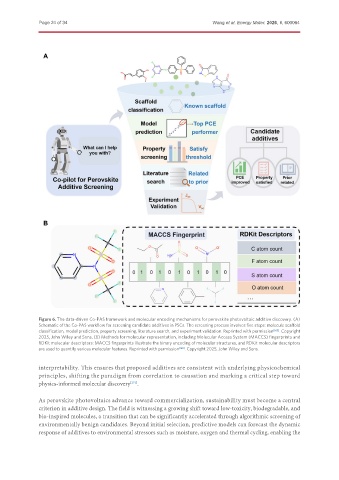
               Figure 6. The data-driven Co-PAS framework and molecular encoding mechanisms for perovskite photovoltaic additive discovery. (A)
               Schematic of the Co-PAS workflow for screening candidate additives in PSCs. The screening process involves five steps: molecule scaffold
               classification, model prediction, property screening, literature search, and experiment validation. Reprinted with permission [165] . Copyright
               2025, John Wiley and Sons. (B) Methods for molecular representation, including Molecular Access System (MACCS) fingerprints and
               RDKit molecular descriptors: MACCS fingerprints illustrate the binary encoding of molecular structures, and RDKit molecular descriptors
               are used to quantify various molecular features. Reprinted with permission [165] . Copyright 2025, John Wiley and Sons.


               interpretability. This ensures that proposed additives are consistent with underlying physicochemical
               principles, shifting the paradigm from correlation to causation and marking a critical step toward
               physics-informed molecular discovery .
                                               [171]

               As perovskite photovoltaics advance toward commercialization, sustainability must become a central
               criterion in additive design. The field is witnessing a growing shift toward low-toxicity, biodegradable, and
               bio-inspired molecules, a transition that can be significantly accelerated through algorithmic screening of
               environmentally benign candidates. Beyond initial selection, predictive models can forecast the dynamic
               response of additives to environmental stressors such as moisture, oxygen and thermal cycling, enabling the

