


Page 32 - Read Online
P. 32
Wang et al. Energy Mater. 2026, 6, 600064                                        Page 25 of 34


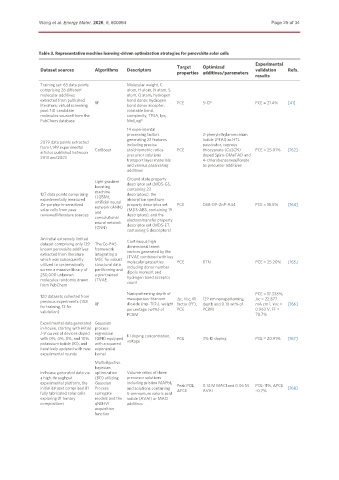
               Table 3. Representative machine learning-driven optimization strategies for perovskite solar cells
                                                                                           Experimental
                                                               Target   Optimized
               Dataset sources    Algorithms  Descriptors                                  validation  Refs.
                                                               properties additives/parameters
                                                                                           results
               Training set: 63 data points   Molecular weight, C
               comprising 26 different        atom, H atom, N atom, S
               molecular additives            atom, O atom, hydrogen
               extracted from published       bond donor, hydrogen
               literature; virtual screening  RF  bond donor acceptor,  PCE  5-CP          PCE = 21.4%  [41]
               pool: 141 candidate            rotatable bond,
               molecules sourced from the     complexity, TPSA, Ipc,
               PubChem database               MolLogP
                                              14 experimental
                                              processing factors        2-phenylethylammonium
                                              generating 22 features    iodide (PEAI) as HTL
               2079 data points extracted     including precise         passivator, cuprous
               from 1,149 experimental  CatBoost  stoichiometric ratios  PCE  thiocyanate (CuSCN)  PCE = 25.01%  [162]
               articles published between     precursor solutions       doped Spiro-OMeTAD and
               2013 and 2023
                                              transport layer materials  4-chlorobenzenesulfonate
                                              and various passivating   as precursor additives
                                              additives
                                              Ground state property
                                  Light gradient  descriptor set (MDS-GS,
                                  boosting    containing 23
                                  machine
               127 data points comprising     descriptors), the
               experimentally measured  (LGBM),  absorption spectrum
               Zn-porphyrin-sensitized  artificial neural  property descriptor set  PCE  D58-DP-ZnP-A44  PCE = 10.5%  [164]
               solar cells from peer  network (ANN)  (MDS-ABS, containing 19
               reviewed literature sources  and  descriptors), and the
                                  convolutional  electron transfer property
                                  neural network  descriptor set (MDS-ET,
                                  (CNN)
                                              containing 5 descriptors)
               An initial extremely limited
               dataset comprising only 129  The Co-PAS  Continuous high
               known perovskite additives  framework  dimensional latent
               extracted from literature  integrating a  vectors generated by the
               which was subsequently  MSC for robust  JTVAE combined with key
               utilized to systematically  structural data  molecular properties  PCE  BTN  PCE = 25.20%  [165]
               screen a massive library of  partitioning and  including donor number
               250,000 unknown    a pre-trained  dipole moment and
               molecules randomly drawn  JTVAE  hydrogen bond acceptor
               from PubChem                   count
                                              Nanopatterning depth of                      PCE = 17.338%,
               120 datasets collected from    mesoporous-titanium
                                                               Jsc, Voc, fill
               previous experiments (108      dioxide (mp-TiO 2 ), weight factor (FF),  127 nm nanopatterning  Jsc = 22.877
                                                                                               -2
               for training, 12 for  RF                                 depth and 0.10 wt% of  mA cm , Voc =  [166]
               validation)                    percentage (wt%) of  PCE  PCBM               0.963 V, FF =
                                              PCBM                                         78.7%
               Experimental data generated Gaussian
               in-house, starting with initial process
               J-V curves of devices doped  regression  KI doping concentration,
               with 0%, 4%, 8%, and 10%  (GPR) equipped  voltage  PCE   3% KI doping       PCE = 20.91%  [167]
               potassium iodide (KI), and  with a squared
               iteratively updated with new exponential
               experimental rounds  kernel
                                  Multiobjective
                                  bayesian
               In-house generated data via  optimization  Volume ratios of three
               a high-throughput  (BO) utilizing  precursor solutions
               experimental platform, the  Gaussian  including pristine MAPbI 3  Peak PCE,  0.14 M MACl and 0.06 M  PCE~11%, ΔPCE
               initial dataset comprised 81  Process  and solutions containing  ΔPCE  AVAI            [168]
               fully fabricated solar cells  surrogate  5-ammonium valeric acid            ~0.7%
               exploring 21 ternary  models and the  iodide (AVAI) or MACl
               compositions       qNEHVI      additives
                                  acquisition
                                  function

