


Page 24 - Read Online
P. 24
Wang et al. Energy Mater. 2026, 6, 600064                                        Page 17 of 34


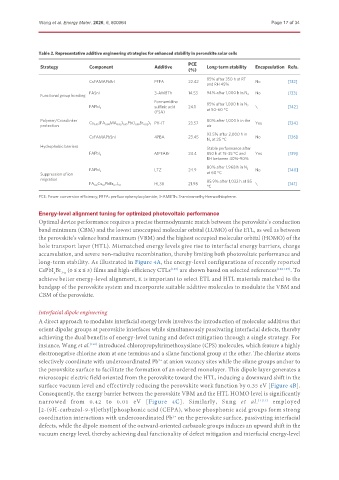
               Table 2. Representative additive engineering strategies for enhanced stability in perovskite solar cells
                                                                   PCE
               Strategy         Component              Additive           Long-term stability  Encapsulation Refs.
                                                                   (%)
                                                                          85% after 350 h at RT
                                CsFAMAPbBrI            PFPA        22.42                   No         [132]
                                                                          and RH 45%
                                FASnI                  3-AMBTh     14.53  94% after 1,000 h in N 2  No  [133]
               Functional group bonding
                                                       Formamidine
                                                       sulfinic acid  24.1  85% after 1,000 h in N 2  \  [142]
                                FAPbI 3                                   at 50-60 °C
                                                       (FSA)
               Polymer/Crosslinker  Cs 0.05 (FA 0.98 MA 0.02 ) 0.95 Pb(I 0.98 Br 0.02 ) 3 PY-IT  23.57  80% after 1,000 h in the  Yes  [134]
               protection                                                 air
                                                                          93.5% after 2,000 h in
                                CsFAMAPbSnI            4PBA        23.45                   No         [136]
                                                                          N 2  at 25 °C
               Hydrophobic barriers                                       Stable performance after
                                                       MPEABr      24.4   850 h at 15-35 °C and  Yes  [139]
                                FAPbI 3
                                                                          RH between 40%-90%
                                                       LTZ         24.9   80% after 1,968 h in N 2  No  [140]
                                FAPbI 3
               Suppression of ion                                         at 60 °C
               migration                                                  85.9% after 1,032 h at 85
                                                       HL38        21.98                   \          [141]
                                FA 0.9 Cs 0.1 PbBr 0.2 I 2.8
                                                                          °C
               PCE: Power conversion efficiency; PFPA: perfluorophenylacylamide; 3-AMBTh: 3-aminomethyl-benzothiophene.
               Energy-level alignment tuning for optimized photovoltaic performance
               Optimal device performance requires a precise thermodynamic match between the perovskite’s conduction
               band minimum (CBM) and the lowest unoccupied molecular orbital (LUMO) of the ETL, as well as between
               the perovskite’s valence band maximum (VBM) and the highest occupied molecular orbital (HOMO) of the
               hole transport layer (HTL). Mismatched energy levels give rise to interfacial energy barriers, charge
               accumulation, and severe non-radiative recombination, thereby limiting both photovoltaic performance and
               long-term stability. As illustrated in Figure 4A, the energy-level configurations of recently reported
               CsPbI Br  (0 ≤ x ≤ 3) films and high-efficiency CTLs [143]  are shown based on selected references [144-149] . To
                       3-x
                    x
               achieve better energy-level alignment, it is important to select ETL and HTL materials matched to the
               bandgap of the perovskite system and incorporate suitable additive molecules to modulate the VBM and
               CBM of the perovskite.

               Interfacial dipole engineering
               A direct approach to modulate interfacial energy levels involves the introduction of molecular additives that
               orient dipolar groups at perovskite interfaces while simultaneously passivating interfacial defects, thereby
               achieving the dual benefits of energy-level tuning and defect mitigation through a single strategy. For
               instance, Wang et al. [150]  introduced chloropropyltrimethoxysilane (CPS) molecules, which feature a highly
               electronegative chlorine atom at one terminus and a silane functional group at the other. The chlorine atoms
               selectively coordinate with undercoordinated Pb  at anion vacancy sites while the silane groups anchor to
                                                         2+
               the perovskite surface to facilitate the formation of an ordered monolayer. This dipole layer generates a
               microscopic electric field oriented from the perovskite toward the HTL, inducing a downward shift in the
               surface vacuum level and effectively reducing the perovskite work function by 0.35 eV [Figure 4B].
               Consequently, the energy barrier between the perovskite VBM and the HTL HOMO level is significantly
               narrowed   from   0.42   to   0.01   eV   [Figure   4C].   Similarly,   Sung   et   al. [151]    employed
               [2-(9H-carbazol-9-yl)ethyl]phosphonic acid (CEPA), whose phosphonic acid groups form strong
               coordination interactions with undercoordinated Pb  on the perovskite surface, passivating interfacial
                                                              2+
               defects, while the dipole moment of the outward-oriented carbazole groups induces an upward shift in the
               vacuum energy level, thereby achieving dual functionality of defect mitigation and interfacial energy-level

