


Page 21 - Read Online
P. 21
Page 14 of 34                                                Wang et al. Energy Mater. 2026, 6, 600064


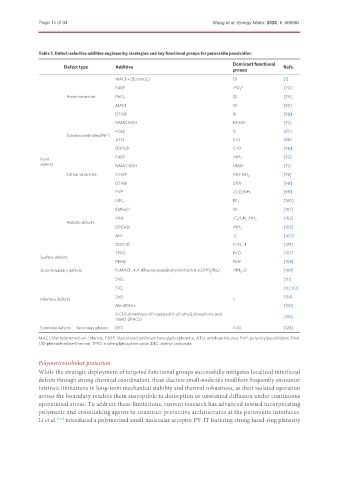
               Table 1. Defect-selective additive engineering strategies and key functional groups for perovskite passivation
                                                                                   Dominant functional
                        Defect type       Additive                                                   Refs.
                                                                                   groups
                                          MACl + [Bcmim]Cl                         Cl -              [1]
                                          FABP                                     -PO 3 2-          [70]
                        Anion vacancies   PbCl 2                                   Cl -              [79]
                                          MACl                                     Cl -              [80]
                                          DTABr                                    Br -              [98]
                                          NMACOOH                                  HCOO -            [71]
                                          H3pp                                     O                 [87]
                        (Undercoordinated Pb )
                                      2+
                                          ATU                                      C=S               [88]
                                          DDPUD                                    C=O               [96]
                                          FABP                                        +              [70]
               Point                                                               -NH 3
               defects                    NMACOOH                                  NMA +             [71]
                        Cation vacancies  2-HZP                                    -NH-NH 2          [72]
                                          DTABr                                    DTA +             [98]
                                          PVP                                      -C(O)NH-          [99]
                                                                                     -               [100]
                                          KBF 4                                    BF 4
                                          EMImCl                                   Cl -              [101]
                                          PAA                                      -C 5 H 4 N, -NH 2  [102]
                        Antisite defects
                                          DPGABr                                   -NH 2             [103]
                                          M4                                       -S                [104]
                                          DDPUD                                    C=O, -F           [129]
                                          TPPO                                     P=O               [107]
               Surface defects
                                          PEABr                                    PEA +             [108]
               Grain boundary defects     FuMACl , 4,4-difluoropiperidinehydrochloride ((DFP) 2 PbI 4 )  -NH 2 , O  [109]
                                                                                                     [111]
                                          SnO 2
                                                                                                     [112,113]
                                          TiO 2
                                          ZnO                                                        [114]
               Interface defects                                                   \
                                          Me-4PACz                                                   [130]
                                          2-(3,6-dimethoxy-9H-carbazol-9-yl) ethyl] phosphonic acid
                                          (MeO-2PACz)                                                [130]
               Extended defects  Secondary phases  DEC                             C=O               [128]

               MACl: Methylammonium chloride; FABP: fluorinated anilinium benzylphosphonate; ATU: amidinethiourea; PVP: polyvinylpyrrolidone; PAA:
               1,10-phenanthroline-5-amine; TPPO: triphenylphosphine oxide; DEC: diethyl carbonate.

               Polymer/crosslinker protection
               While the strategic deployment of targeted functional groups successfully mitigates localized interfacial
               defects through strong chemical coordination, these discrete small-molecule modifiers frequently encounter
               intrinsic limitations in long-term mechanical stability and thermal robustness, as their isolated operation
               across the boundary renders them susceptible to desorption or unwanted diffusion under continuous
               operational stress. To address these limitations, current research has advanced toward incorporating
               polymeric and crosslinking agents to construct protective architectures at the perovskite interfaces.
               Li et al.  introduced a polymerized small-molecular acceptor PY-IT featuring strong fused-ring planarity
                     [134]

