


Page 8 - Read Online
P. 8
Page 4 of 17                    Zhang et al. Carbon Footprints 2025, 4, 36  https://dx.doi.org/10.20517/cf.2025.29

               Table 1. Farm structure at the household level, and input data at three stocking rates in Maqu County on the QTP
                         No of yaks  Pasture area   Stocking rate  DM   Electricity consumption   Gasoline consumption
                Treatment                          -1          -1          -1               -1
                         (head)   (ha)        (yak ha )  (kg day )  (kWh year )         (t year )
                HSR      103 ± 25  56.00 ± 10.90  1.83 ± 0.11  18.20 ± 6.78  200.0 ± 18.3  0.21 ± 0.18
                MSR      90 ± 17  88.83 ± 19.17  1.02 ± 0.03  28.77 ± 10.03  209.0 ± 33.4  0.22 ± 0.06
                LSR      74 ± 27  104.47 ± 32.88  0.65 ± 0.01  22.97 ± 9.12  191.0 ± 31.4  0.22 ± 0.09

               Mean ± SD (n = 3); HSR: High stocking rate; MSR: moderate stocking rate; LSR: low stocking rate. DM is the dry manure consumption each day.


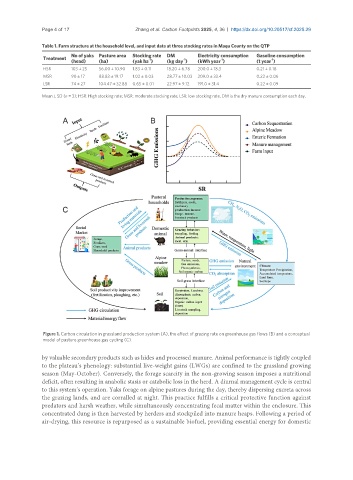
                Figure 1. Carbon circulation in grassland production system (A), the effect of grazing rate on greenhouse gas flows (B) and a conceptual
                model of pasture greenhouse gas cycling (C).

               by valuable secondary products such as hides and processed manure. Animal performance is tightly coupled
               to the plateau’s phenology: substantial live-weight gains (LWGs) are confined to the grassland growing
               season (May-October). Conversely, the forage scarcity in the non-growing season imposes a nutritional
               deficit, often resulting in anabolic stasis or catabolic loss in the herd. A diurnal management cycle is central
               to this system’s operation. Yaks forage on alpine pastures during the day, thereby dispersing excreta across
               the grazing lands, and are corralled at night. This practice fulfills a critical protective function against
               predators and harsh weather, while simultaneously concentrating fecal matter within the enclosure. This
               concentrated dung is then harvested by herders and stockpiled into manure heaps. Following a period of
               air-drying, this resource is repurposed as a sustainable biofuel, providing essential energy for domestic

