


Page 55 - Read Online
P. 55
Geng et al. Carbon Footprints 2025, 4, 8  https://dx.doi.org/10.20517/cf.2025.02  Page 11 of 15


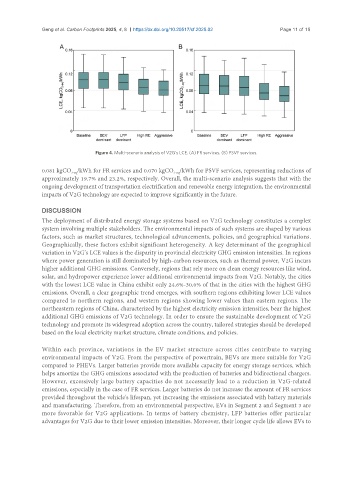
                                 Figure 4. Multi-scenario analysis of V2G’s LCE. (A) FR services. (B) PSVF services.

               0.081 kgCO /kWh for FR services and 0.070 kgCO /kWh for PSVF services, representing reductions of
                         2-eq
                                                            2-eq
               approximately 19.7% and 23.2%, respectively. Overall, the multi-scenario analysis suggests that with the
               ongoing development of transportation electrification and renewable energy integration, the environmental
               impacts of V2G technology are expected to improve significantly in the future.


               DISCUSSION
               The deployment of distributed energy storage systems based on V2G technology constitutes a complex
               system involving multiple stakeholders. The environmental impacts of such systems are shaped by various
               factors, such as market structures, technological advancements, policies, and geographical variations.
               Geographically, these factors exhibit significant heterogeneity. A key determinant of the geographical
               variation in V2G’s LCE values is the disparity in provincial electricity GHG emission intensities. In regions
               where power generation is still dominated by high-carbon resources, such as thermal power, V2G incurs
               higher additional GHG emissions. Conversely, regions that rely more on clean energy resources like wind,
               solar, and hydropower experience lower additional environmental impacts from V2G. Notably, the cities
               with the lowest LCE value in China exhibit only 24.6%-30.0% of that in the cities with the highest GHG
               emissions. Overall, a clear geographic trend emerges, with southern regions exhibiting lower LCE values
               compared to northern regions, and western regions showing lower values than eastern regions. The
               northeastern regions of China, characterized by the highest electricity emission intensities, bear the highest
               additional GHG emissions of V2G technology. In order to ensure the sustainable development of V2G
               technology and promote its widespread adoption across the country, tailored strategies should be developed
               based on the local electricity market structure, climate conditions, and policies.


               Within each province, variations in the EV market structure across cities contribute to varying
               environmental impacts of V2G. From the perspective of powertrain, BEVs are more suitable for V2G
               compared to PHEVs. Larger batteries provide more available capacity for energy storage services, which
               helps amortize the GHG emissions associated with the production of batteries and bidirectional chargers.
               However, excessively large battery capacities do not necessarily lead to a reduction in V2G-related
               emissions, especially in the case of FR services. Larger batteries do not increase the amount of FR services
               provided throughout the vehicle's lifespan, yet increasing the emissions associated with battery materials
               and manufacturing. Therefore, from an environmental perspective, EVs in Segment 2 and Segment 3 are
               more favorable for V2G applications. In terms of battery chemistry, LFP batteries offer particular
               advantages for V2G due to their lower emission intensities. Moreover, their longer cycle life allows EVs to

