


Page 48 - Read Online
P. 48
Page 4 of 15                     Geng et al. Carbon Footprints 2025, 4, 8  https://dx.doi.org/10.20517/cf.2025.02


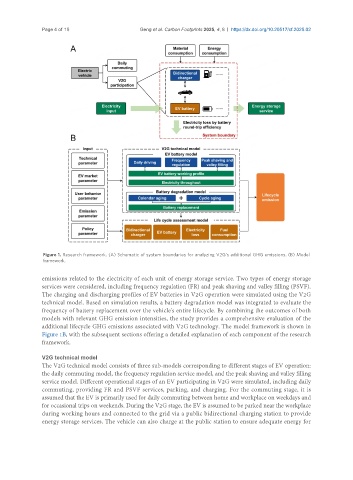
                Figure 1. Research framework. (A) Schematic of system boundaries for analyzing V2G’s additional GHG emissions. (B) Model
                framework.


               emissions related to the electricity of each unit of energy storage service. Two types of energy storage
               services were considered, including frequency regulation (FR) and peak shaving and valley filling (PSVF).
               The charging and discharging profiles of EV batteries in V2G operation were simulated using the V2G
               technical model. Based on simulation results, a battery degradation model was integrated to evaluate the
               frequency of battery replacement over the vehicle's entire lifecycle. By combining the outcomes of both
               models with relevant GHG emission intensities, the study provides a comprehensive evaluation of the
               additional lifecycle GHG emissions associated with V2G technology. The model framework is shown in
               Figure 1B, with the subsequent sections offering a detailed explanation of each component of the research
               framework.


               V2G technical model
               The V2G technical model consists of three sub-models corresponding to different stages of EV operation:
               the daily commuting model, the frequency regulation service model, and the peak shaving and valley filling
               service model. Different operational stages of an EV participating in V2G were simulated, including daily
               commuting, providing FR and PSVF services, parking, and charging. For the commuting stage, it is
               assumed that the EV is primarily used for daily commuting between home and workplace on weekdays and
               for occasional trips on weekends. During the V2G stage, the EV is assumed to be parked near the workplace
               during working hours and connected to the grid via a public bidirectional charging station to provide
               energy storage services. The vehicle can also charge at the public station to ensure adequate energy for

