


Page 81 - Read Online
P. 81
Choi et al. Cancer Drug Resist. 2026;9:12                                         Page 7 of 20


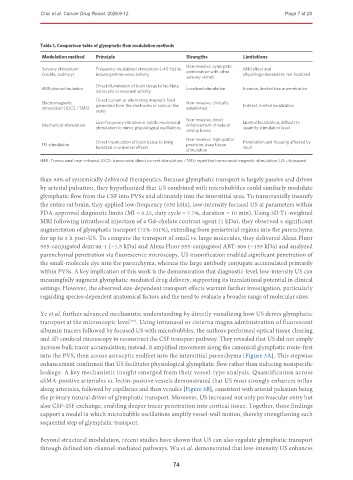
               Table 1. Comparison table of glymphatic flow modulation methods
               Modulation method  Principle                     Strengths          Limitations

                                                                Non-invasive, synergistic
               Sensory stimulation  Frequency-modulated stimulation (~40 Hz) to    Mild effect and
               (visible, auditory)  induce gamma-wave activity  combination with other  physiology-dependent, not localized
                                                                sensory stimuli
                                 Direct illumination of brain tissue to facilitate
               tNIR photostimulation                            Localized stimulation  Invasive, limited tissue penetration
                                 astrocytic or neuronal activity
                                 Direct current or alternating magnetic field
               Electromagnetic                                  Non-invasive, clinically
               stimulation (tDCS, rTMS)  generated from the electrodes or coils on the  established  Indirect, limited localization
                                 scalp
                                                                Non-invasive, direct
                                 Low-frequency vibration or subtle mechanical      Limited localization, difficult to
               Mechanical stimulation                           enhancement of natural
                                 stimulation to mimic physiological oscillations   quantify stimulation level
                                                                driving forces
                                                                Non-invasive, high spatial
                                 Direct insonication of brain tissue to bring      Penetration and focusing affected by
               US stimulation                                   precision, deep tissue
                                 localized or universal effects                    skull
                                                                stimulation
               tNIR: Transcranial near-infrared; tDCS: transcranial direct current stimulation; rTMS: repetitive transcranial magnetic stimulation; US: ultrasound.
               than 98% of systemically delivered therapeutics. Because glymphatic transport is largely passive and driven
               by arterial pulsation, they hypothesized that US combined with microbubbles could similarly modulate
               glymphatic flow from the CSF into PVSs and ultimately into the interstitial area. To transcranially insonify
               the entire rat brain, they applied low-frequency (650 kHz), low-intensity focused US at parameters within
               FDA-approved diagnostic limits (MI = 0.25, duty cycle = 7.7%, duration = 10 min). Using 3D T1-weighted
               MRI following intrathecal injection of a Gd-chelate contrast agent (1 kDa), they observed a significant
               augmentation of glymphatic transport (72%-101%), extending from periarterial regions into the parenchyma
               for up to 3 h post-US. To compare the transport of small vs. large molecules, they delivered Alexa Fluor
               555-conjugated dextran-1 (~1.5 kDa) and Alexa Fluor 555-conjugated ABT-806 (~155 kDa) and analyzed
               parenchymal penetration via fluorescence microscopy. US insonification enabled significant penetration of
               the small-molecule dye into the parenchyma, whereas the large antibody conjugate accumulated primarily
               within PVSs. A key implication of this work is the demonstration that diagnostic-level, low-intensity US can
               meaningfully augment glymphatic-mediated drug delivery, supporting its translational potential in clinical
               settings. However, the observed size-dependent transport effects warrant further investigation, particularly
               regarding species-dependent anatomical factors and the need to evaluate a broader range of molecular sizes.


               Ye et al. further advanced mechanistic understanding by directly visualizing how US drives glymphatic
               transport at the microscopic level . Using intranasal or cisterna magna administration of fluorescent
                                             [63]
               albumin tracers followed by focused US with microbubbles, the authors performed optical tissue clearing
               and 3D confocal microscopy to reconstruct the CSF transport pathway. They revealed that US did not simply
               increase bulk tracer accumulation; instead, it amplified movement along the canonical glymphatic route–first
               into the PVS, then across astrocytic endfeet into the interstitial parenchyma [Figure 3A]. This stepwise
               enhancement confirmed that US facilitates physiological glymphatic flow rather than inducing nonspecific
               leakage. A key mechanistic insight emerged from their vessel-type analysis. Quantification across
               αSMA-positive arterioles vs. lectin-positive vessels demonstrated that US most strongly enhances influx
               along arterioles, followed by capillaries and then venules [Figure 3B], consistent with arterial pulsation being
               the primary natural driver of glymphatic transport. Moreover, US increased not only perivascular entry but
               also CSF–ISF exchange, enabling deeper tracer penetration into cortical tissue. Together, these findings
               support a model in which microbubble oscillations amplify vessel-wall motion, thereby strengthening each
               sequential step of glymphatic transport.


               Beyond structural modulation, recent studies have shown that US can also regulate glymphatic transport
               through defined ion-channel-mediated pathways. Wu et al. demonstrated that low-intensity US enhances

                                                           74

