


Page 79 - Read Online
P. 79
Choi et al. Cancer Drug Resist. 2026;9:12                                         Page 5 of 20


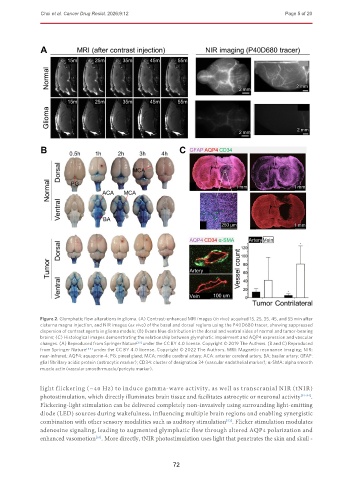
               Figure 2. Glymphatic flow alterations in glioma. (A) Contrast-enhanced MRI images (in vivo) acquired 15, 25, 35, 45, and 55 min after
               cisterna magna injection, and NIR images (ex vivo) of the basal and dorsal regions using the P40D680 tracer, showing suppressed
               dispersion of contrast agents in glioma models; (B) Evans blue distribution in the dorsal and ventral sides of normal and tumor-bearing
               brains; (C) Histological images demonstrating the relationship between glymphatic impairment and AQP4 expression and vascular
               changes. (A) Reproduced from Springer Nature [32]  under the CC BY 4.0 license. Copyright © 2019 The Authors. (B and C) Reproduced
               from Springer Nature [44]  under the CC BY 4.0 license. Copyright © 2022 The Authors. MRI: Magnetic resonance imaging; NIR:
               near-infrared; AQP4: aquaporin-4; PG: pineal gland; MCA: middle cerebral artery; ACA: anterior cerebral artery; BA: basilar artery; GFAP:
               glial fibrillary acidic protein (astrocytic marker); CD34: cluster of designation 34 (vascular endothelial marker); α-SMA: alpha smooth
               muscle actin (vascular smooth-muscle/pericyte marker).


               light flickering (~40 Hz) to induce gamma-wave activity, as well as transcranial NIR (tNIR)
               photostimulation, which directly illuminates brain tissue and facilitates astrocytic or neuronal activity [51-54] .
               Flickering-light stimulation can be delivered completely non-invasively using surrounding light-emitting
               diode (LED) sources during wakefulness, influencing multiple brain regions and enabling synergistic
               combination with other sensory modalities such as auditory stimulation . Flicker stimulation modulates
                                                                             [51]
               adenosine signaling, leading to augmented glymphatic flow through altered AQP4 polarization and
               enhanced vasomotion . More directly, tNIR photostimulation uses light that penetrates the skin and skull -
                                 [53]


                                                           72

