


Page 75 - Read Online
P. 75
Review  |  Open Access

                                    Cancer Drug Resistance


                                       Choi et al. Cancer Drug Resist. 2026;9:12      DOI:10.20517/cdr.2025.223


               Ultrasonic modulation of brain glymphatic transport:
               from observations to theranostic applications


               Wonseok Choi , Min-Hyeok Jang , Chulhong Kim , Eun-Yeong Park 4
                           1
                                          2
                                                        3
               Keywords:
               Glymphatic system, brain,
               ultrasound modulation, drug
               delivery

               Citation: Choi W, Jang MH,
               Kim C, Park EY. Ultrasonic
               modulation of brain
               glymphatic transport: from
               observations to theranostic
               applications. Cancer Drug
               Resist. 2026;9:12.
               https://dx.doi.org/10.20517
               /cdr.2025.223

               Received: 12 Dec 2025
               First Decision: 26 Jan
               2026
               Revised: 9 Feb 2026  Abstract
               Accepted: 23 Mar 2026
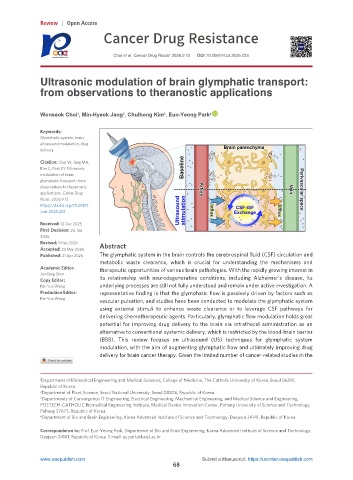
               Published: 21 Apr 2026  The glymphatic system in the brain controls the cerebrospinal fluid (CSF) circulation and
                                   metabolic   waste   clearance,   which   is   crucial   for   understanding   the   mechanisms   and
               Academic Editor:    therapeutic opportunities of various brain pathologies. With the rapidly growing interest in
               Jianliang Shen
               Copy Editor:        its   relationship   with   neurodegenerative   conditions,   including   Alzheimer’s   disease,   its
               Pei-Yun Wang        underlying processes are still not fully understood and remain under active investigation. A
               Production Editor:  representative finding is that the glymphatic flow is passively driven by factors such as
               Pei-Yun Wang
                                   vascular pulsation, and studies have been conducted to modulate the glymphatic system
                                   using   external   stimuli   to   enhance   waste   clearance   or   to   leverage   CSF   pathways   for
                                   delivering chemotherapeutic agents. Particularly, glymphatic flow modulation holds great
                                   potential   for   improving   drug   delivery   to   the   brain   via   intrathecal   administration   as   an
                                   alternative to conventional systemic delivery, which is restricted by the blood-brain barrier
                                   (BBB).   This   review   focuses   on   ultrasound   (US)   techniques   for   glymphatic   system
                                   modulation, with the aim of augmenting glymphatic flow and ultimately improving drug
                                   delivery for brain cancer therapy. Given the limited number of cancer-related studies in the


               1 Department of Biomedical Engineering and Medical Sciences, College of Medicine, The Catholic University of Korea, Seoul 06591,
               Republic of Korea.
               2 Department of Plant Science, Seoul National University, Seoul 08826, Republic of Korea.
               3 Departments of Convergence IT Engineering, Electrical Engineering, Mechanical Engineering, and Medical Science and Engineering,
               POSTECH-CATHOLIC Biomedical Engineering Institute, Medical Device Innovation Center, Pohang University of Science and Technology,
               Pohang 37673, Republic of Korea.
               4 Department of Bio and Brain Engineering, Korea Advanced Institute of Science and Technology, Daejeon 34141, Republic of Korea.

               Correspondence to: Prof. Eun-Yeong Park, Department of Bio and Brain Engineering, Korea Advanced Institute of Science and Technology,
               Daejeon 34141, Republic of Korea. E-mail: ey.park@kaist.ac.kr


               www.oaepublish.com                                    Submit a Manuscript: https://ucenter.oaepublish.com
                                                           68

