


Page 124 - Read Online
P. 124
Page 4 of 13 Fang et al. Cancer Drug Resist. 2025;8:42
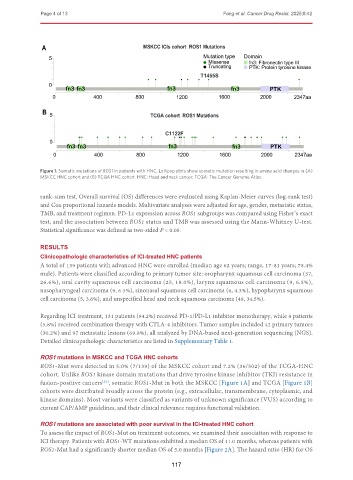
Figure 1. Somatic mutations of ROS1 in patients with HNC. Lollipop plots show somatic mutation resulting in amino acid changes in (A)
MSKCC HNC cohort and (B) TCGA HNC cohort. HNC: Head and neck cancer; TCGA: The Cancer Genome Atlas.
rank-sum test. Overall survival (OS) differences were evaluated using Kaplan-Meier curves (log-rank test)
and Cox proportional hazards models. Multivariate analyses were adjusted for age, gender, metastatic status,
TMB, and treatment regimen. PD-L1 expression across ROS1 subgroups was compared using Fisher’s exact
test, and the association between ROS1 status and TMB was assessed using the Mann-Whitney U-test.
Statistical significance was defined as two-sided P < 0.05.
RESULTS
Clinicopathologic characteristics of ICI-treated HNC patients
A total of 139 patients with advanced HNC were enrolled (median age 62 years; range, 17-81 years; 78.4%
male). Patients were classified according to primary tumor site: oropharynx squamous cell carcinoma (37,
26.6%), oral cavity squamous cell carcinoma (25, 18.0%), larynx squamous cell carcinoma (9, 6.5%),
nasopharyngeal carcinoma (9, 6.5%), sinonasal squamous cell carcinoma (6, 4.3%), hypopharynx squamous
cell carcinoma (5, 3.6%), and unspecified head and neck squamous carcinoma (48, 34.5%).
Regarding ICI treatment, 131 patients (94.2%) received PD-1/PD-L1 inhibitor monotherapy, while 8 patients
(5.8%) received combination therapy with CTLA-4 inhibitors. Tumor samples included 42 primary tumors
(30.2%) and 97 metastatic lesions (69.8%), all analyzed by DNA-based next-generation sequencing (NGS).
Detailed clinicopathologic characteristics are listed in Supplementary Table 1.
ROS1 mutations in MSKCC and TCGA HNC cohorts
ROS1-Mut were detected in 5.0% (7/139) of the MSKCC cohort and 7.2% (36/502) of the TCGA-HNC
cohort. Unlike ROS1 kinase domain mutations that drive tyrosine kinase inhibitor (TKI) resistance in
fusion-positive cancers , somatic ROS1-Mut in both the MSKCC [Figure 1A] and TCGA [Figure 1B]
[26]
cohorts were distributed broadly across the protein (e.g., extracellular, transmembrane, cytoplasmic, and
kinase domains). Most variants were classified as variants of unknown significance (VUS) according to
current CAP/AMP guidelines, and their clinical relevance requires functional validation.
ROS1 mutations are associated with poor survival in the ICI-treated HNC cohort
To assess the impact of ROS1-Mut on treatment outcomes, we examined their association with response to
ICI therapy. Patients with ROS1-WT mutations exhibited a median OS of 11.0 months, whereas patients with
ROS1-Mut had a significantly shorter median OS of 5.0 months [Figure 2A]. The hazard ratio (HR) for OS
117

