


Page 86 - Read Online
P. 86
Page 472                         Wang et al. Art Int Surg. 2025;5:465-75  https://dx.doi.org/10.20517/ais.2025.03

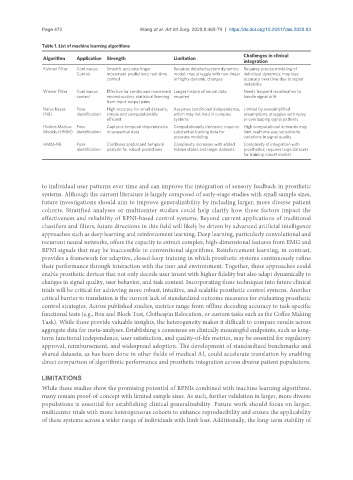
               Table 1. List of machine learning algorithms
                                                                                   Challenges in clinical
                Algorithm  Application  Strength            Limitation
                                                                                   integration
                Kalman Filter  Continuous   Smooth, accurate finger   Requires detailed system dynamics  Requires precise modeling of
                           Control   movement predictions; real-time   model; may struggle with non-linear  individual dynamics; may lose
                                     control                or highly dynamic changes  accuracy over time due to signal
                                                                                   instability
                Wiener Filter  Continuous   Effective for continuous movement  Longer history of neural data   Needs frequent recalibration to
                           control   reconstruction; statistical learning  required  handle signal drift
                                     from input-output pairs
                Naïve Bayes   Pose   High accuracy for small datasets;   Assumes conditional independence,  Limited by oversimplified
                (NB)       identification  simple and computationally   which may not hold in complex   assumptions; struggles with noisy
                                     efficient              systems                or overlapping signal patterns
                Hidden Markov  Pose   Captures temporal dependencies   Computationally intensive; requires  High computational demands may
                Models (HMM) identification  in sequential data  substantial training data for   limit real-time use; sensitive to
                                                            accurate modeling      variations in signal quality
                HMM-NB     Pose      Combines spatial and temporal   Complexity increases with added   Complexity of integration with
                           identification  analysis for robust predictions  hidden states and larger datasets  prosthetics; requires large datasets
                                                                                   for training robust models


               to individual user patterns over time and can improve the integration of sensory feedback in prosthetic
               systems. Although the current literature is largely composed of early-stage studies with small sample sizes,
               future investigations should aim to improve generalizability by including larger, more diverse patient
               cohorts. Stratified analyses or multicenter studies could help clarify how these factors impact the
               effectiveness and reliability of RPNI-based control systems. Beyond current applications of traditional
               classifiers and filters, future directions in this field will likely be driven by advanced artificial intelligence
               approaches such as deep learning and reinforcement learning. Deep learning, particularly convolutional and
               recurrent neural networks, offers the capacity to extract complex, high-dimensional features from EMG and
               RPNI signals that may be inaccessible to conventional algorithms. Reinforcement learning, in contrast,
               provides a framework for adaptive, closed-loop training in which prosthetic systems continuously refine
               their performance through interaction with the user and environment. Together, these approaches could
               enable prosthetic devices that not only decode user intent with higher fidelity but also adapt dynamically to
               changes in signal quality, user behavior, and task context. Incorporating these techniques into future clinical
               trials will be critical for achieving more robust, intuitive, and scalable prosthetic control systems. Another
               critical barrier to translation is the current lack of standardized outcome measures for evaluating prosthetic
               control strategies. Across published studies, metrics range from offline decoding accuracy to task-specific
               functional tests (e.g., Box and Block Test, Clothespin Relocation, or custom tasks such as the Coffee Making
               Task). While these provide valuable insights, the heterogeneity makes it difficult to compare results across
               aggregate data for meta-analyses. Establishing a consensus on clinically meaningful endpoints, such as long-
               term functional independence, user satisfaction, and quality-of-life metrics, may be essential for regulatory
               approval, reimbursement, and widespread adoption. The development of standardized benchmarks and
               shared datasets, as has been done in other fields of medical AI, could accelerate translation by enabling
               direct comparison of algorithmic performance and prosthetic integration across diverse patient populations.


               LIMITATIONS
               While these studies show the promising potential of RPNIs combined with machine learning algorithms,
               many remain proof-of-concept with limited sample sizes. As such, further validation in larger, more diverse
               populations is essential for establishing clinical generalizability. Future work should focus on larger,
               multicenter trials with more heterogeneous cohorts to enhance reproducibility and ensure the applicability
               of these systems across a wider range of individuals with limb loss. Additionally, the long-term stability of

