


Page 83 - Read Online
P. 83
Wang et al. Art Int Surg. 2025;5:465-75  https://dx.doi.org/10.20517/ais.2025.03     Page 469


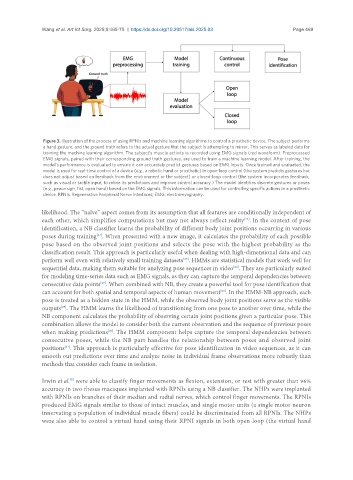
                Figure 3. Illustration of the process of using RPNIs and machine learning algorithms to control a prosthetic device. The subject performs
                a hand gesture, and the ground truth refers to the actual gesture that the subject is attempting to mirror. This serves as labeled data for
                training the machine learning algorithm. The subject’s muscle activity is recorded using EMG signals (red waveform). Preprocessed
                EMG signals, paired with their corresponding ground truth gestures, are used to train a machine learning model. After training, the
                model’s performance is evaluated to ensure it can accurately predict gestures based on EMG inputs. Once trained and evaluated, the
                model is used for real-time control of a device (e.g., a robotic hand or prosthetic) in open-loop control (the system predicts gestures but
                does not adjust based on feedback from the environment or the subject) or closed-loop control (the system incorporates feedback,
                such as visual or tactile input, to refine its predictions and improve control accuracy.) The model identifies discrete gestures or poses
                (e.g., peace sign, fist, open hand) based on the EMG signals. This information can be used for controlling specific actions in a prosthetic
                device. RPNIs: Regenerative Peripheral Nerve Interfaces; EMG: electromyography.


               likelihood. The “naïve” aspect comes from its assumption that all features are conditionally independent of
               each other, which simplifies computations but may not always reflect reality . In the context of pose
                                                                                   [23]
               identification, a NB classifier learns the probability of different body joint positions occurring in various
               poses during training . When presented with a new image, it calculates the probability of each possible
                                  [24]
               pose based on the observed joint positions and selects the pose with the highest probability as the
               classification result. This approach is particularly useful when dealing with high-dimensional data and can
                                                               [25]
               perform well even with relatively small training datasets . HMMs are statistical models that work well for
                                                                                [26]
               sequential data, making them suitable for analyzing pose sequences in video . They are particularly suited
               for modeling time-series data such as EMG signals, as they can capture the temporal dependencies between
               consecutive data points . When combined with NB, they create a powerful tool for pose identification that
                                   [27]
               can account for both spatial and temporal aspects of human movement . In the HMM-NB approach, each
                                                                           [28]
               pose is treated as a hidden state in the HMM, while the observed body joint positions serve as the visible
               outputs . The HMM learns the likelihood of transitioning from one pose to another over time, while the
                      [29]
               NB component calculates the probability of observing certain joint positions given a particular pose. This
               combination allows the model to consider both the current observation and the sequence of previous poses
               when making predictions . The HMM component helps capture the temporal dependencies between
                                     [30]
               consecutive poses, while the NB part handles the relationship between poses and observed joint
               positions . This approach is particularly effective for pose identification in video sequences, as it can
                       [31]
               smooth out predictions over time and analyze noise in individual frame observations more robustly than
               methods that consider each frame in isolation.

               Irwin et al.  were able to classify finger movements as flexion, extension, or rest with greater than 96%
                         [8]
               accuracy in two rhesus macaques implanted with RPNIs using a NB classifier. The NHPs were implanted
               with RPNIs on branches of their median and radial nerves, which control finger movements. The RPNIs
               produced EMG signals similar to those of intact muscles, and single motor units (a single motor neuron
               innervating a population of individual muscle fibers) could be discriminated from all RPNIs. The NHPs
               were also able to control a virtual hand using their RPNI signals in both open-loop (the virtual hand

