


Page 14 - Read Online
P. 14
Page 29                                                                                                                                                            Landau et al. Art Int Surg. 2025;5:24-35  https://dx.doi.org/10.20517/ais.2024.78


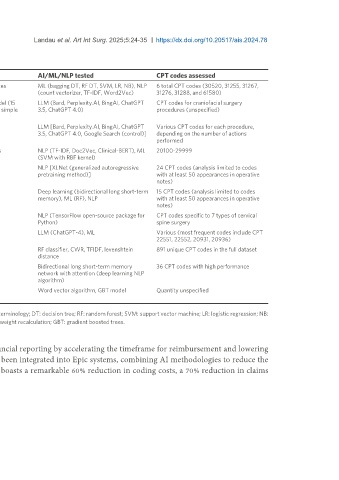
 Table 1. Study characteristics

 Author  Year Study design  Procedure domain(s)  Sample size  AI/ML/NLP tested  CPT codes assessed
 [13]
 Cheng et al.  2024 Retrospective cohort   Head and neck surgery  549 total operative notes  ML (bagging DT, RF DT, SVM, LR, NB), NLP   6 total CPT codes (30520, 31255, 31267,
 study        (count vectorizer, TF-IDF, Word2Vec)      31276, 31288, and 61580)
 [14]
 Isch et al.  2024 Observational study  Craniofacial surgery  20 procedures per model (15   LLM (Bard, Perplexity.AI, BingAI, ChatGPT   CPT codes for craniofacial surgery
 complex procedures, 5 simple   3.5, ChatGPT 4.0)       procedures (unspecified)
 procedures)
 [15]
 O’Malley et al.  2024 Comparative   Neurosurgery (endovascular,   30 total procedures  LLM [Bard, Perplexity.AI, BingAI, ChatGPT   Various CPT codes for each procedure,
 performance   spinal, cranial procedures)  3.5, ChatGPT 4.0, Google Search (control)]  depending on the number of actions
 evaluation                                             performed
 [10]
 Tavabi et al.  2024 Retrospective cohort   Orthopedic surgery and sports   44002 operative notes  NLP (TF-IDF, Doc2Vec, Clinical-BERT), ML   20100-29999
 study  medicine  (SVM with RBF kernel)
 [16]
 Zaidat et al.  2024 Retrospective cohort   Spine surgery  922 operative notes  NLP [XLNet (generalized autoregressive   24 CPT codes (analysis limited to codes
 study        pretraining method)]                      with at least 50 appearances in operative
                                                        notes)
 [17]
 Kim et al.  2023 Retrospective cohort   Spine surgery  391 operative notes  Deep learning (bidirectional long short-term   15 CPT codes (analysis limited to codes
 study        memory), ML (RF), NLP                     with at least 50 appearances in operative
                                                        notes)
 [18]
 Shost et al.  2023 Retrospective cohort   Spine surgery  12239 operative notes  NLP (TensorFlow open-source package for   CPT codes specific to 7 types of cervical
 study        Python)                                   spine surgery
 [19]
 Zaidat et al.  2023 Retrospective cohort   Spine surgery  50 operative notes  LLM (ChatGPT-4), ML  Various (most frequent codes include CPT
 study                                                  22551, 22552, 20931, 20936)
 [7]
 Khaleghi et al.  2021 Retrospective   General surgery  28,000 patients  RF classifier, CWR, TFIDF, levenshtein   891 unique CPT codes in the full dataset
 observational study  distance
 [20]
 Kim et al.  2020 Retrospective cohort   Spine surgery  391 operative notes  Bidirectional long short-term memory   36 CPT codes with high performance
 study        network with attention (deep learning NLP
              algorithm)
 [21]
 Brat et al.  2015 Retrospective cross-  Abdominal openings/closure  92,886 patients  Word vector algorithm, GBT model  Quantity unspecified
 sectional study

 AI: Artificial intelligence; ML: machine learning; NLP: natural language processing; CPT: current procedural terminology; DT: decision tree; RF: random forest; SVM: support vector machine; LR: logistic regression; NB:
 Naïve Bayes; TF-IDF: term frequency-inverse document frequency; LLM: large language model; CWR: class weight recalculation; GBT: gradient boosted trees.


 patients to enhance the precision of loss reserve estimates, which is vital to financial reporting by accelerating the timeframe for reimbursement and lowering

 [28]
 the chance of billing errors . In another example, CodaMetrix has previously been integrated into Epic systems, combining AI methodologies to reduce the
 workload of human coding. In fact, the CodaMetrix CMX Automate solution boasts a remarkable 60% reduction in coding costs, a 70% reduction in claims
 denials, and an acceleration of compensation processing (time to cash) .
 [29]

