


Page 70 - Read Online
P. 70
Bala et al. Art Int Surg. 2025;5:476-89  https://dx.doi.org/10.20517/ais.2025.44    Page 484

               Table 3. Comparison of structured information extraction performance with and without RAG
                                Accuracy without RAG (%,  Accuracy with RAG (%,             P-value (0.05)
                Field evaluated                                          Common error
                                95% CI)              95%CI)                                 (exact)
                Report date     67 (60.1-73.5)       81 (75.1-86.2)      Misinterpretation (Type 1),   > 0.05 (0.062)
                                                                         Unsupported output (Type 2)
                Flag adverse events  83 (79.4-87.8)  99 (96.4-99.9)      Misinterpretation  < 0.05 (0.001)
                Hernia type     60 (56.1-66.7)       82 (76.1-87.2)      Misinterpretation, missing   < 0.05 (0.032)
                                                                         context
                Adverse events  60 (58.4-65.4)       86 (80.7-90.5)      Partial event capture  < 0.05 (0.018)
                Jaccard overlap (event   75 (69.7-80.7)  88.9 (84.1-92.8)  Misinterpretation (Type 1),   < 0.05 (0.025)
                match)                                                   Unsupported output (Type 2)
               RAG: Retrieval-Augmented Generation.


               Table 4. Adverse event extraction template from FDA reports
                Adverse   adverse_events_template =
                events    AE 1:
                template  AE 2:
                          AE 3:
                          AE 4:
                          ...
                          AE 10:
                Prompt    prompt_template = [INST]<<SYS|||<*** You are an intelligent system designed to extract adverse event information from
                template  patient reports. <</SYS|||<***
                          Using the context provided, identify up to ten adverse events (each in four words or fewer) related to pain, discomfort,
                          reactions, or device complications. If no adverse event is clearly mentioned, respond with “no event mentioned.” Do not include
                          inferred or speculative information.

                          context: [FDA_mesh_report]
                          adverse events template: [adverse_events_template]
                          filled template: [/INST]
                Input     [ID] had severe pain, not been able to eat, vomiting. I suspect that the mesh migration is adding to my issues. Disturbing
                          sensation of something moving inside.
                Output    AE 1: severe pain
                          AE 2: vomiting
                          AE 3: mesh migration
                          AE 4: no event mentioned
                          ...
                          AE10: no event mentioned

               FDA: Food and Drug Administration; AE: adverse event; ID: identity of the report.

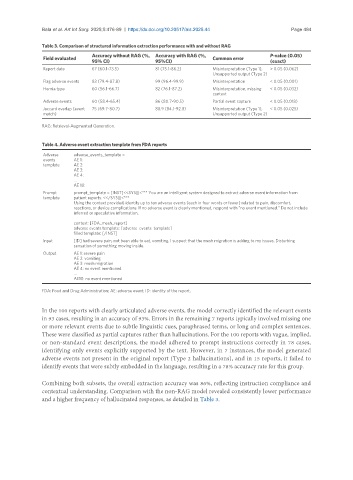
               In the 100 reports with clearly articulated adverse events, the model correctly identified the relevant events
               in 93 cases, resulting in an accuracy of 93%. Errors in the remaining 7 reports typically involved missing one
               or more relevant events due to subtle linguistic cues, paraphrased terms, or long and complex sentences.
               These were classified as partial captures rather than hallucinations. For the 100 reports with vague, implied,
               or non-standard event descriptions, the model adhered to prompt instructions correctly in 78 cases,
               identifying only events explicitly supported by the text. However, in 7 instances, the model generated
               adverse events not present in the original report (Type 2 hallucinations), and in 15 reports, it failed to
               identify events that were subtly embedded in the language, resulting in a 78% accuracy rate for this group.


               Combining both subsets, the overall extraction accuracy was 86%, reflecting instruction compliance and
               contextual understanding. Comparison with the non-RAG model revealed consistently lower performance
               and a higher frequency of hallucinated responses, as detailed in Table 3.

