


Page 73 - Read Online
P. 73
Johnson et al. Art Int Surg 2024;4:401-10  https://dx.doi.org/10.20517/ais.2024.40                                                       Page 403

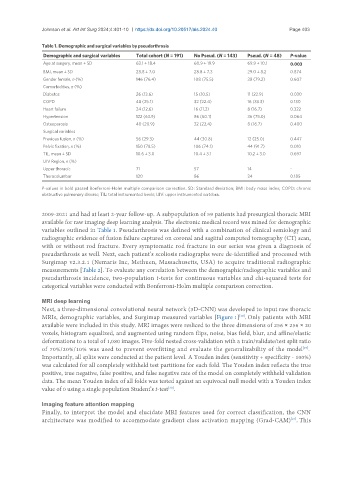
               Table 1. Demographic and surgical variables by pseudarthrosis
                Demographic and surgical variables  Total cohort (N = 191)  No Pseud. (N = 143)  Pseud. (N = 48)  P-value
                Age at surgery, mean ± SD      63.1 ± 18.4        60.9 ± 19.9       69.9 ± 10.1    0.003
                BMI, mean ± SD                 28.8 ± 7.0         28.8 ± 7.3        29.0 ± 8.2     0.874
                Gender female, n (%)           146 (76.4)         108 (75.5)        38 (79.2)      0.607
                Comorbidities, n (%)
                Diabetes                       26 (13.6)          15 (10.5)         11 (22.9)      0.030
                COPD                           48 (25.1)          32 (22.4)         16 (33.3)      0.130
                Heart failure                  24 (12.6)          16 (11.2)         8 (16.7)       0.322
                Hypertension                   122 (63.9)         86 (60.1)         36 (75.0)      0.064
                Osteoporosis                   40 (20.9)          32 (22.4)         8 (16.7)       0.400
                Surgical variables
                Previous fusion, n (%)         56 (29.3)          44 (30.8)         12 (25.0)      0.447
                Pelvic fixation, n (%)         150 (78.5)         106 (74.1)        44 (91.7)      0.010
                TIL, mean ± SD                 10.6 ± 3.0         10.4 ± 3.1        10.2 ± 3.0     0.697
                UIV Region, n (%)
                Upper thoracic                 71                 57                14             -
                Thoracolumbar                  120                86                34             0.185
               P-values in bold passed Bonferroni-Holm multiple comparison correction. SD: Standard deviation; BMI: body mass index; COPD: chronic
               obstructive pulmonary disease; TIL: total instrumented levels; UIV: upper instrumented vertebra.


               2009-2021 and had at least 2-year follow-up. A subpopulation of 59 patients had presurgical thoracic MRI
               available for raw imaging deep learning analysis. The electronic medical record was mined for demographic
               variables outlined in Table 1. Pseudarthrosis was defined with a combination of clinical semiology and
               radiographic evidence of fusion failure captured on coronal and sagittal computed tomography (CT) scan,
               with or without rod fracture. Every symptomatic rod fracture in our series was given a diagnosis of
               pseudarthrosis as well. Next, each patient’s scoliosis radiographs were de-identified and processed with
               Surgimap v2.3.2.1 (Nemaris Inc, Methuen, Massachusetts, USA) to acquire traditional radiographic
               measurements [Table 2]. To evaluate any correlation between the demographic/radiographic variables and
               pseudarthrosis incidence, two-population t-tests for continuous variables and chi-squared tests for
               categorical variables were conducted with Bonferroni-Holm multiple comparison correction.


               MRI deep learning
               Next, a three-dimensional convolutional neural network (3D-CNN) was developed to input raw thoracic
               MRIs, demographic variables, and Surgimap measured variables [Figure 1] . Only patients with MRI
                                                                                  [18]
               available were included in this study. MRI images were resliced to the three dimensions of 256 × 256 × 20
               voxels, histogram equalized, and augmented using random flips, noise, bias field, blur, and affine/elastic
               deformations to a total of 1,080 images. Five-fold nested cross-validation with a train/validate/test split ratio
               of 70%/20%/10% was used to prevent overfitting and evaluate the generalizability of the model .
                                                                                                       [19]
               Importantly, all splits were conducted at the patient level. A Youden index (sensitivity + specificity - 100%)
               was calculated for all completely withheld test partitions for each fold. The Youden index reflects the true
               positive, true negative, false positive, and false negative rate of the model on completely withheld validation
               data. The mean Youden index of all folds was tested against an equivocal null model with a Youden index
               value of 0 using a single population Student’s t-test .
                                                          [20]

               Imaging feature attention mapping
               Finally, to interpret the model and elucidate MRI features used for correct classification, the CNN
               architecture was modified to accommodate gradient class activation mapping (Grad-CAM) . This
                                                                                                   [21]

