


Page 55 - Read Online
P. 55
Page 2 of 10                                                   Scotti et al. Vessel Plus 2021;5:6  I  http://dx.doi.org/10.20517/2574-1209.2020.68


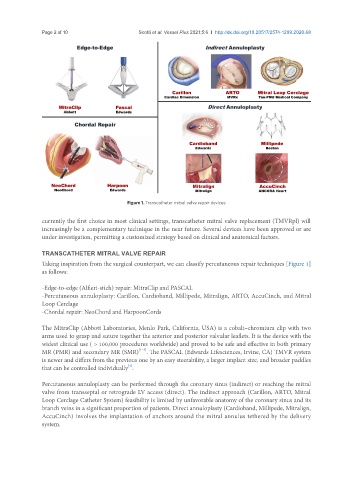
                                            Figure 1. Transcatheter mitral valve repair devices

               currently the first choice in most clinical settings, transcatheter mitral valve replacement (TMVRpl) will
               increasingly be a complementary technique in the near future. Several devices have been approved or are
               under investigation, permitting a customized strategy based on clinical and anatomical factors.

               TRANSCATHETER MITRAL VALVE REPAIR
               Taking inspiration from the surgical counterpart, we can classify percutaneous repair techniques [Figure 1]
               as follows:


               -Edge-to-edge (Alfieri-stich) repair: MitraClip and PASCAL
               -Percutaneous annuloplasty: Carillon, Cardioband, Millipede, Mitralign, ARTO, AccuCinch, and Mitral
               Loop Cerclage
               -Chordal repair: NeoChord and HarpoonCords


               The MitraClip (Abbott Laboratories, Menlo Park, California, USA) is a cobalt–chromium clip with two
               arms used to grasp and suture together the anterior and posterior valvular leaflets. It is the device with the
               widest clinical use ( > 100,000 procedures worldwide) and proved to be safe and effective in both primary
               MR (PMR) and secondary MR (SMR)  [1–3] . The PASCAL (Edwards Lifesciences, Irvine, CA) TMVR system
               is newer and differs from the previous one by an easy steerability, a larger implant size, and broader paddles
                                            [4]
               that can be controlled individually .

               Percutaneous annuloplasty can be performed through the coronary sinus (indirect) or reaching the mitral
               valve from transseptal or retrograde LV access (direct). The indirect approach (Carillon, ARTO, Mitral
               Loop Cerclage Catheter System) feasibility is limited by unfavorable anatomy of the coronary sinus and its
               branch veins in a significant proportion of patients. Direct annuloplasty (Cardioband, Millipede, Mitralign,
               AccuCinch) involves the implantation of anchors around the mitral annulus tethered by the delivery
               system.

