


Page 85 - Read Online
P. 85
Page 4 of 10                  Walter et al. Vessel Plus 2021;5:27  https://dx.doi.org/10.20517/2574-1209.2020.102


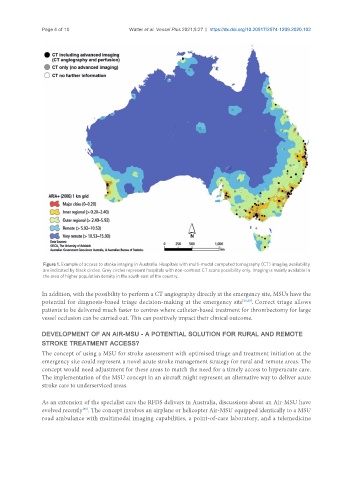
                Figure 1. Example of access to stroke imaging in Australia. Hospitals with multi-modal computed tomography (CT) imaging availability
                are indicated by black circles. Grey circles represent hospitals with non-contrast CT scans possibility only. Imaging is mainly available in
                the area of higher population density in the south east of the country.

               In addition, with the possibility to perform a CT angiography directly at the emergency site, MSUs have the
               potential for diagnosis-based triage decision-making at the emergency site [25,29] . Correct triage allows
               patients to be delivered much faster to centres where catheter-based treatment for thrombectomy for large
               vessel occlusion can be carried out. This can positively impact their clinical outcome.


               DEVELOPMENT OF AN AIR-MSU - A POTENTIAL SOLUTION FOR RURAL AND REMOTE
               STROKE TREATMENT ACCESS?
               The concept of using a MSU for stroke assessment with optimised triage and treatment initiation at the
               emergency site could represent a novel acute stroke management strategy for rural and remote areas. The
               concept would need adjustment for these areas to match the need for a timely access to hyperacute care.
               The implementation of the MSU concept in an aircraft might represent an alternative way to deliver acute
               stroke care to underserviced areas.


               As an extension of the specialist care the RFDS delivers in Australia, discussions about an Air-MSU have
                             [30]
               evolved recently . The concept involves an airplane or helicopter Air-MSU equipped identically to a MSU
               road ambulance with multimodal imaging capabilities, a point-of-care laboratory, and a telemedicine

