


Page 37 - Read Online
P. 37
Page 2 of 12                                                   Zhao et al. Vessel Plus 2021;5:10  I  http://dx.doi.org/10.20517/2574-1209.2020.77


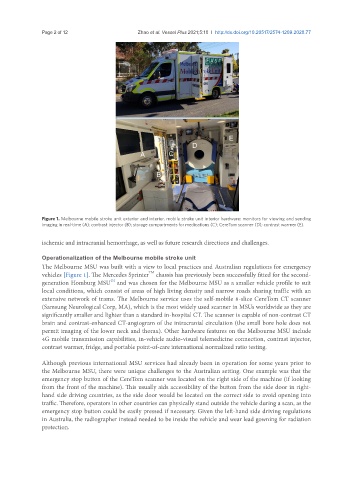
               Figure 1. Melbourne mobile stroke unit exterior and interior. mobile stroke unit interior hardware: monitors for viewing and sending
               imaging in real-time (A); contrast injector (B); storage compartments for medications (C); CereTom scanner (D); contrast warmer (E).

               ischemic and intracranial hemorrhage, as well as future research directions and challenges.

               Operationalization of the Melbourne mobile stroke unit
               The Melbourne MSU was built with a view to local practices and Australian regulations for emergency
                                                   TM
               vehicles [Figure 1]. The Mercedes Sprinter  chassis has previously been successfully fitted for the second-
                                      [3]
               generation Homburg MSU  and was chosen for the Melbourne MSU as a smaller vehicle profile to suit
               local conditions, which consist of areas of high living density and narrow roads sharing traffic with an
               extensive network of trams. The Melbourne service uses the self-mobile 8-slice CereTom CT scanner
               (Samsung Neurological Corp, MA), which is the most widely used scanner in MSUs worldwide as they are
               significantly smaller and lighter than a standard in-hospital CT. The scanner is capable of non-contrast CT
               brain and contrast-enhanced CT-angiogram of the intracranial circulation (the small bore hole does not
               permit imaging of the lower neck and thorax). Other hardware features on the Melbourne MSU include
               4G mobile transmission capabilities, in-vehicle audio-visual telemedicine connection, contrast injector,
               contrast warmer, fridge, and portable point-of-care international normalized ratio testing.

               Although previous international MSU services had already been in operation for some years prior to
               the Melbourne MSU, there were unique challenges to the Australian setting. One example was that the
               emergency stop button of the CereTom scanner was located on the right side of the machine (if looking
               from the front of the machine). This usually aids accessibility of the button from the side door in right-
               hand side driving countries, as the side door would be located on the correct side to avoid opening into
               traffic. Therefore, operators in other countries can physically stand outside the vehicle during a scan, as the
               emergency stop button could be easily pressed if necessary. Given the left-hand side driving regulations
               in Australia, the radiographer instead needed to be inside the vehicle and wear lead gowning for radiation
               protection.

